


Page 72 - TD-2-2
P. 72
Tumor Discovery                                                   SRT with SIP planning for synovial sarcoma


                                                                                                           ®
            performed. Celiac axis and common hepatic artery were   a 4D was acquired thanks to a respiratory belt (Philips );
            clearly infiltrated by tumor and a surgical clip was left for   second, a triphasic contrast-enhanced CT study was
            post-operative guidance purposes. Pathologic examination   performed. Both the studies used a slice thickness of
            confirmed an SS relapse, with a vital cellularity of 40%, and   1.5 mm.
            also confirmed the specimen translocation of locus SS18   Planning was performed on average CT to take into
            (SYT-18q11.2). All four lymph nodes removed resulted   account tumor and organs at risk (OARs) motion. In
            negative for tumor involvement. Moreover, pathologic   details, on Velocity (Varian ) treatment planning system
                                                                                     ®
            report confirmed the presence of invasive tumor at surgical   (TPS), each of the ten respiratory phases was exploited to
            margin (extensively R2 resection). The patient recovered   define the position of the tumor, the stomach, duodenum,
            without major complication and was discharged in good   jejunum, and colon.
            clinical conditions; acute toxicity  was  represented  by
            limitation of solid oral intake determined by G2 dyspepsia   As a result, ten regions of interest  were created  for
            in the following 2 months.                         the stomach, duodenum, and the critical area of jejunum
                                                               proximal to target. Moreover, internal margin (IM)
              Taking into account the macroscopic persistence of   representing the maximum position of the stomach,
            disease, at the end of June 2021, the patient was evaluated by   duodenum,  and jejunum was created. For  stomach and
            a radiation oncologist that proposed a normofractionated   jejunum near to the target, a planning respect volume
            treatment consisting of 59.4  Gy in 33 fractions versus   (PRV) was crated with an isotropic expansion of 2 mm.
            60  Gy in 30 fractions on the sites of persistent disease.
            A second approach was performed at our center, with the   For target definition, exploiting all the information
            propose to study the feasibility of an hypofractionated   derived from diagnostic CT and contrast-enhanced planning
            schedule, optimally stereotactic body RT in 5 – 6 fractions.   CT, after co-registration to each respiratory phase, a gross
            Our choice for hypofractionation was aimed at maximum   tumor  volume  (GTV)  was  defined  on  each  respiratory
            tumor control probability, given the well-known intrinsic   phase. The sum of GTV of each phase formed the internal
            radioresistance of the histologic subtype to standard   target volume  (ITV)  that virtually represents the area, in
            normofractionated regimens.                        which GTV moves during the respiratory cycle. A margin
                                                               accounting for set-up errors and unpredictable organ motion
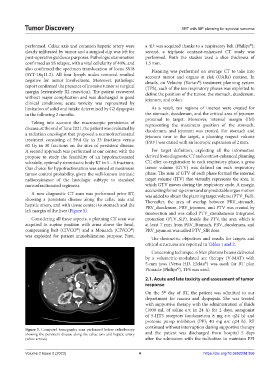
              A new diagnostic CT scan was performed prior RT,   was added to obtain the planning target volume (PTV_Full).
            showing  a persistent  disease  along  the  celiac  axis  and   Thereafter, the area of overlap between PRV_stomach,
            hepatic artery, and with tissue contact to stomach and the   PRV_duodenum, PRV_jejunum, and PTV was created by
            left margin of the liver (Figure 5).
                                                               intersection and was called PTV_simultaneous integrated
              Considering all these aspects, a planning CT scan was   protection (PTV_SIP). Inside the PTV, the area which is
            acquired in supine position with arms above the head,   at least 7 mm from PRV_Stomach, PRV_duodenum, and
                                                         ®
                                  ®
            compressing Belt (CIVCO ) and a Monarch (CIVCO )   PRV_jejunum was called PTV_SIB dose.
            was exploited for patient immobilization purpose. First,   The dosimetric objectives and results for targets  and
                                                               critical structures are reported in Tables 1 and 2.
                                                                 Concerning technique, 6 Mev photons beams delivered
                                                               by a volumetric-modulated arc therapy (V-MAT) with
                                                               5-mm  jaws (Versa HD, Elekta ) was used; for RT  plan
                                                                                        ®
                                                               Pinnacle (Philips ), TPS was used.
                                                                            ®
                                                               2.1. Acute and late toxicity and assessment of tumor
                                                               response
                                                                       th
                                                               On the 5   day of RT, the patient was admitted to our
                                                               department for nausea and dyspepsia. She was treated
                                                               with supportive therapy with the administration of fluids
                                                               (1000  mL of saline e.v. in 24  h) for 2  days, antagonist
                                                               of 5-HT3 receptors (ondansetron 8  mg e.v. q24 h) and
                                                               protonic pump inhibitors (PPI; 40  mg e.v. q24 h). RT
                                                               continued without interruption during supportive therapy
            Figure  5. Computed tomography scan performed before radiotherapy
            showing the persistent disease along the celiac axis and hepatic artery   and  the  patient  was  discharged  from  hospital 5  days
            (white arrows).                                    after the admission with the indication to maintain PPI


            Volume 2 Issue 2 (2023)                         4                           https://doi.org/10.36922/td.356

