


Page 73 - TD-2-2
P. 73
Tumor Discovery                                                   SRT with SIP planning for synovial sarcoma


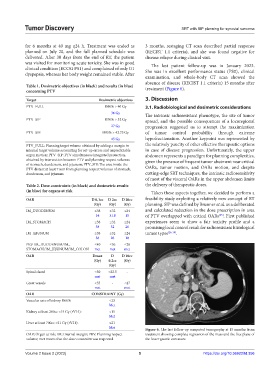
            for  6  months  at  40  mg  q24  h.  Treatment  was  ended  as   3  months, restaging CT scan described partial response
            planned on July 20, and the full planned schedule was   (RECIST 1.1 criteria), and she was found negative for
            delivered. After 30 days from the end of RT, the patient   disease relapse during clinical visit.
            was visited for monitoring acute toxicity. She was in good   The last patient follow-up was in January 2023.
            clinical condition (ECOG PS1) and complained of only G1   She  was  in  excellent  performance  status  (PS0),  clinical
            dyspepsia, whereas her body weight remained stable. After
                                                               examination, and whole-body CT scan showed the
                                                               absence of disease (RECIST 1.1 criteria) 15 months after
            Table 1. Dosimetric objectives (in black) and results (in blue)
            concerning PTV                                     treatment (Figure 6).

            Target                         Dosimetric objectives  3. Discussion
            PTV_FULL                          D80% > 40 Gy     3.1. Radiobiological and dosimetric considerations
                                                36 Gy          The intrinsic radioresistant phenotype, the site of tumor
            PTV_SIP                           D70% > 32 Gy     spread, and the possible consequences of a locoregional
                                                27 Gy          progression suggested us  to attempt  the  maximization
            PTV_SIB                          D95% > 42.75 Gy   of  tumor  control  probability  through  extreme
                                                45 Gy          hypofractionation. Another keypoint was represented by
            PTV_FULL: Planning target volume obtained by adding a margin to   the relatively paucity of other effective therapeutic options
            internal target volume accounting for set-up errors and unpredictable   in case of disease progression. Unfortunately, the upper
            organ motion; PTV_SIP: PTV simultaneous integrated protection,   abdomen represents a paradigm for planning complexities,
            obtained by intersection between PTV and planning respect volumes   given the presence of frequent tumor abutment near critical
            of stomach, duodenum, and jejunum; PTV_SIB: The area inside the
            PTV distant at least 7 mm from planning respect volumes of stomach,   OARs, tumor motion, and OARs motion, and despite
            duodenum, and jejunum                              cutting-edge SRT techniques, the intrinsic radiosensitivity
                                                               of most of the visceral OARs in the upper abdomen limits
            Table 2. Dose constraints (in black) and dosimetric results   the delivery of therapeutic doses.
            (in blue) for organs at risk                         Taken these aspects together, we decided to perform a
            OAR                         D 0,1cc  D 2cc  D 20cc  feasibility study exploiting a relatively new concept of RT
                                         (Gy)  (Gy)   (Gy)     planning. SIP was defined by Brunner et al. as a deliberated
            IM_DUODENUM                  ≤38    ≤32   ≤24      and calculated reduction in the dose prescription in area
                                          34    31.8  15       of PTV overlapped with critical OARs . First published
                                                                                              [25]
            IM_STOMACH                   ≤38    ≤32   ≤24      experiences  seem to show a fair toxicity profile  and  a
                                          38    32    26       promising local control result for radioresistant histological
            IM_JEJUNUM                   ≤38    ≤32   ≤24      tumor types [26-30] .
                                          38    28    18
            PRV IM_DUODENUM/IM_          ≤40    ≤36   ≤28
            STOMACH/IM_JEJUNUM/IM_COLON  met    met   met
            OAR                         Dmax    D    D 10cc
                                         (Gy)  0.2cc  (Gy)
                                               (Gy)
            Spinal chord                 <30   <22.5   -
                                         met    met
            Great vessels                <55     -    <47
                                         met          met
            OAR                         CONSTRAINT (Gy)
            Vascular axis of kidney D66%        <23
                                               Met
            Kidney at least 200cc <15 Gy (rV15):  <15
                                               Met
            Liver at least 700cc <21 Gy (rV21):  ≤21
                                               Met             Figure 6. The last follow-up computed tomography at 15 months from
            OAR: Organ at risk; IM: Internal margin; PRV: Planning respect   treatment showing complete regression of the mass and the free plane of
            volume; met means that the dose constraint was respected  the lesser gastric curvature.


            Volume 2 Issue 2 (2023)                         5                           https://doi.org/10.36922/td.356

