


Page 70 - TD-2-2
P. 70
Tumor Discovery                                                   SRT with SIP planning for synovial sarcoma


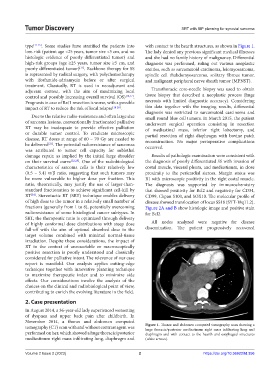
            type [11-15] . Some studies  have stratified the patients into   with contact to the hearth structures, as shown in Figure 1.
            low-risk (patient age <25 years, tumor size <5 cm, and no   The lady denied any previous significant medical illnesses
            histologic evidence of poorly differentiated tumor) and   and she had no family history of malignancy. Differential
            high-risk groups (age ≥25 years, tumor size ≥5 cm, and   diagnosis was performed, ruling out various neoplastic
            poorly differentiated tumor) . Backbone therapy for SS   entities, such as sarcomatoid carcinoma, leiomyosarcoma,
                                   [11]
            is represented by radical surgery, with polychemotherapy   spindle cell rhabdomyosarcoma, solitary fibrous tumor,
            with ifosfamide-adriamycin before or after surgical   and malignant peripheral nerve sheath tumor (MPNST).
            treatment. Classically, RT is used in neoadjuvant and
            adjuvant  context,  with  the  aim  of  maximizing  local   Transthoracic core-needle biopsy was used to obtain
            control and possibly increasing overall survival (OS) [16,17] .   tissue biopsy that described a neoplastic process (huge
            Prognosis in case of Rx/1 resection is worse, with a possible   necrosis with limited diagnostic accuracy). Considering
            impact of RT to reduce the risk of local relapse [18-20] .  this data together with the imaging results, differential
                                                               diagnosis was restricted to sarcomatoid carcinoma and
              Due to the relative radio-resistance and often large size   small round blue cell tumors. In March 2015, the patient
            of sarcoma lesions, conventionally fractionated palliative   underwent  surgical  operation  consisting  in  resection
            RT may be inadequate to provide effective palliation   of mediastinal mass, inferior right lobectomy, and
            or durable tumor control. To eradicate microscopic   partial resection of right diaphragm with bovine patch
            disease, RT doses at range of 60 – 70 Gy are needed to   reconstruction. No major perioperative complications
                      [21]
            be delivered . The potential radioresistance of sarcomas   occurred.
            was attributed to tumor cell capacity for sublethal
            damage repair, as implied by the initial large shoulder   Results of pathologic examination were consistent with
            on their survival curve [22,23] . One of the radiobiological   the diagnosis of poorly differentiated SS with invasion of
            characteristics of sarcoma cells is their relatively low   costal muscle, visceral pleura, and mediastinum, in close
            (0.5 – 5.4)  α/β ratio, suggesting that such tumors may   proximity to the pericardial sierosa. Margin status was
            be more vulnerable to higher dose per fraction. This   R1 with microscopic positivity in the right costal muscle.
            ratio, theoretically, may justify the use of larger-than-  The diagnosis was supported by immunochemistry
            standard fractionation to achieve significant cell-kill by   that showed positivity for Bcl2 and negativity for CD34,
            RT . Stereotactic RT (SRT) technique enables delivery   CD99, Ckpan S100, and SOX10. The molecular profile of
              [24]
            of high dose to the tumor in a relatively small number of   disease showed translocation of locus SS18 (SYT-18q11.2).
            fractions (generally from 1 to 8), potentially overcoming   Figure 2A and B show histologic image and positive stain
            radioresistance of some histological cancer subtypes. In   for Bcl2.
            SRT, the therapeutic ratio is optimized through delivery
            of highly conformal dose distributions with steep dose   All nodes analyzed were negative for disease
            fall-off with the aim of optimal absorbed dose in the   dissemination. The  patient progressively  recovered
            target volume combined with minimal normal-tissue
            irradiation. Despite these considerations, the impact of
            RT in the context of unresectable or macroscopically
            positive resection is poorly understood and classically
            considered for palliative intent. The relevance of our case
            report  is manifold. Our analysis applies  cutting-edge
            technique together with innovative planning technique
            to maximize therapeutic index and to minimize side
            effects. Our considerations involve the analysis of the
            choices on the clinical and radiobiological point of view,
            contributing to enrich the evolving literature in the field.
            2. Case presentation

            In August 2014, a 36-year-old lady experienced worsening
            of dyspnea and upper back pain after childbirth. In
            November 2014, a thorax and abdomen computed
            tomography (CT) scan with and without contrast agent was   Figure 1. Thorax and abdomen computed tomography scan showing a
                                                               huge  thoracic/posterior  mediastinum  right  mass  infiltrating  lung  and
            performed on her, which showed a huge thoracic/posterior   diaphragm and with contact to the hearth and esophageal structures
            mediastinum right mass infiltrating lung, diaphragm and   (white arrows).


            Volume 2 Issue 2 (2023)                         2                           https://doi.org/10.36922/td.356

