


Page 27 - TD-3-3
P. 27
Tumor Discovery                                                Adjuvant immunotherapy in high-risk melanoma


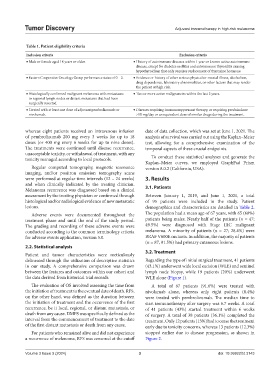
            Table 1. Patient eligibility criteria
            Inclusion criteria                                               Exclusion criteria
            •  Male or female aged 18 years or older.     •  History of autoimmune diseases within 1 year or known active autoimmune
                                                           disease, except for diabetes mellitus and autoimmune thyroiditis causing
                                                           hypothyroidism that only requires replacement of thyroxine hormone.
            •  Eastern Cooperative Oncology Group performance status of 0 – 2.  •  Evidence or history of other serious physical or mental illness, alcoholism,
                                                           drug dependence, laboratory abnormalities, or other factors that may render
                                                           the patient at high risk.
            •  Histologically confirmed malignant melanoma with metastases   •  Two or more active malignancies within the last 2 years.
             to regional lymph nodes or distant metastasis that had been
             surgically resected.
            •  Treated with at least one dose of adjuvant pembrolizumab or   •  Diseases requiring immunosuppressant therapy, or requiring prednisolone
             nivolumab.                                    >10 mg/day or an equivalent dose of similar drugs during the treatment.


            whereas eight patients received an intravenous infusion   date of data collection, which was set at June 1, 2021. The
            of  pembrolizumab  200  mg  every  3  weeks  for  up  to 18   analysis of survival was carried out using the Kaplan–Meier
            doses (or 400  mg every 6  weeks for up to nine doses).   test, allowing for a comprehensive examination of the
            The treatments were continued until disease recurrence,   temporal aspects of these crucial endpoints.
            unacceptable toxicity, or withdrawal of treatment, with any
            toxicity managed according to local protocols.       To conduct these statistical analyses and generate the
                                                               Kaplan–Meier curves, we employed  GraphPad Prism
              Regular computed tomography, magnetic resonance   version 8.0.2 (California, USA).
            imaging,  and/or  positron  emission  tomography  scans
            were performed at regular time intervals (12 – 24 weeks)   3. Results
            and when clinically indicated by the treating clinician.   3.1. Patients
            Melanoma recurrence was diagnosed based on a clinical
            assessment by the treating physician or confirmed through   Between January 1, 2019, and June 1, 2021, a total
            histological and/or radiological evidence of new metastatic   of 95  patients were included in the study. Patient
            lesions.                                           demographics and characteristics are detailed in Table 2.
              Adverse events were documented throughout the    The population had a mean age of 67 years, with 65 (68%)
            treatment phase and until  the end of the  study period.   patients being males. Nearly half of the patients (n = 47;
            The grading and recording of these adverse events were   49.5%)  were diagnosed  with  Stage IIIC  malignant
            conducted according to the common terminology criteria   melanoma. A minority of patients (n = 27; 28.4%) were
            for adverse events application, version 5.0.       BRAF V600E mutants. In addition, the majority of patients
                                                               (n = 87, 91.5%) had primary cutaneous lesions.
            2.2. Statistical analysis
                                                               3.2. Treatment
            Patient and tumor characteristics were meticulously
            delineated through the utilization of descriptive statistics   Regarding the type of initial surgical treatment, 41 patients
            in our study. A  comprehensive comparison was drawn   (43.1%) underwent wide local excision (WLE) and sentinel
            between the features and outcomes within our cohort and   lymph node biopsy, while 19  patients (20%) underwent
            the data derived from historical trial records.    WLE alone (Figure 1).
              The evaluation of OS involved assessing the time from   A total of 87  patients (91.6%) were treated with
            the initiation of treatment to the eventual date of death. RFS,   nivolumab alone, whereas only eight patients (8.4%)
            on the other hand, was defined as the duration between   were treated with pembrolizumab. The median time to
            the initiation of treatment and the occurrence of the first   start immunotherapy after surgery was 6.7 weeks. A total
            recurrence, be it local, regional, or distant metastasis, or   of  41  patients  (43%) started treatment  within  6  weeks
            death from any cause. DMFS was specifically defined as the   of surgery. A total of 38 patients (36.1%) completed the
            interval from the commencement of treatment to the date   treatment. Only 12 patients (13%) had to cease the treatment
            of the first distant metastasis or death from any cause.  early due to toxicity concerns, whereas 13 patients (12.3%)
              For patients who remained alive and did not experience   stopped earlier due to disease progression, as shown in
            a recurrence of melanoma, RFS was censored at the cutoff   Figure 2.


            Volume 3 Issue 3 (2024)                         3                                 doi: 10.36922/td.3143

