


Page 51 - TD-3-3
P. 51
Tumor Discovery                                        Somatic mutations in POLE and POLD1 in colorectal cancer


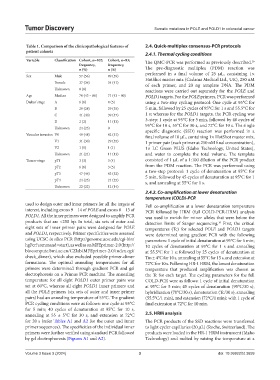
            Table 1. Comparison of the clinicopathological features of   2.4. Quick-multiplex consensus-PCR protocols
            patient cohorts
                                                               2.4.1. Thermal cycling conditions
            Variable    Classification Cohort, n=102;   Cohort, n=83;   The QMC-PCR was performed as previously described.
                                                                                                            16
                                   frequency,    frequency,
                                   n (%)       n (%)           The pre-diagnostic multiplex (PDM) reaction was
            Sex         Male       57 (56)     49 (59)         performed in a final volume of 25  µL, containing 1×
                                                               HotShot master mix (Cadama Medical Ltd., UK), 250 nM
                        Female     37 (36)     34 (41)         of each primer, and 20  ng template DNA. The PDM
                        Unknown    8 (8)                       reactions were carried out separately for the  POLE and
            Age         Median     70 (43 – 88)  71 (43 – 80)  POLD1 targets. For the POLE primers, PCR was performed
            Dukes’ stage  A        6 (6)       4 (5)           using a two-step cycling protocol: One cycle at 95°C for
                        B          29 (28)     29 (35)         5 min, followed by 25 cycles of 95°C for 1 s and 55.5°C for
                        C          41 (40)     39 (47)         1 s; whereas for the POLD1 targets, the PCR cycling was
                                                               3-step: 1 cycle at 95°C for 5 min, followed by 40 cycles of
                        D          2 (2)       11 (13)
                        Unknown    24 (23)     0               95°C for 10 s, 55°C for 30 s, and 72°C for 10 s. The single
                                                               specific diagnostic (SSD) reaction was performed in a
            Vascular invasion V0   49 (48)     42 (51)         final volume of 10 µL, containing 1× HotShot master mix,
                        V1         31 (30)     29 (35)         1 primer pair (each primer at 250 nM final concentration),
                        V2         1 (1)       1 (1)           1× LC Green PLUS (Idaho Technology, United States),
                        Unknown    21 (21)     11 (13)         and water to complete the total volume. The template
            Tumor stage  pT1       3 (3)       3 (4)           consisted of 1 µL of a 1:100 dilution of the PCR product
                        pT2        6 (6)       3 (5)           from the PDM reaction. The PCR was performed using
                        pT3        47 (46)     43 (52)         a two-step protocol: 1 cycle of denaturation at 95°C for
                        pT4        24 (23)     21 (25)         5 min, followed by 45 cycles of denaturation at 95°C for 1
                                                               s, and annealing at 55°C for 1 s.
                        Unknown    22 (22)     12 (14)
                                                               2.4.2. Co-amplification at lower denaturation
                                                               temperature (COLD)-PCR
            used to design outer and inner primers for all the targets of   Full co-amplification at a lower denaturation temperature
            interest, including exons 9 – 14 of POLE and exons 8 – 13 of   PCR followed by HRM (full COLD-PCR-HRM) analysis
            POLD1. All the inner primers were designed to amplify PCR   was used to enrich for minor alleles that were below the
            products that are <250 bp. In total, six sets of outer and   detection limits of Sanger sequencing.  First, the critical
                                                                                              18
            eight sets of inner primer pairs were designed for POLE   temperatures (Tc) for selected  POLE and  POLD1 targets
            and POLD1, respectively. Primer specificities were assessed   were determined using gradient PCR with the following
            using UCSC in silico PCR (http://genome.ucsc.edu/cgi-bin/  parameters: 1 cycle of initial denaturation at 95°C for 5 min;
            hgPcr?command=start), as well as on MFEprimer-2.0 (http://  10  cycles of denaturation at 95°C for 1 s and annealing
            biocompute.bmi.ac.cn/CZlab/MFEprimer-2.0/index.cgi/  at 55.5°C for 1 s; followed by 25 cycles of denaturation at
            check_dimer), which also excluded possible primer-dimer   Tm ± 4°C for 10 s, annealing at 55°C for 15 s, and extension at
            formations. The optimal annealing temperatures for all   72°C for 10 s. Following HR-1 HRM, the lowest denaturation
            primers were determined through gradient PCR and gel   temperature that produced amplification was chosen as
            electrophoresis on a Primus PCR machine. The annealing   the Tc for each target. The cycling parameters for the full
            temperature for all eight POLD1 outer primer pairs was   COLD-PCR were as follows: 1 cycle of initial denaturation
            set at 60°C, whereas all eight POLD1 inner primers and   at 95°C for 5 min; 45 cycles of denaturation (95°C/30 s),
            all the POLE primers (six sets of outer and inner primer   hybridization (70°C/30 s), denaturation (Tc/30 s), annealing
            pairs) had an annealing temperature of 55°C. The gradient   (55.5°C/1 min), and extension (72°C/1 min); with 1 cycle of
            PCR cycling conditions were as follows: one cycle at 95°C   final extension at 72°C for 10 min.
            for 5  min; 40  cycles  of denaturation at  95°C for  10  s,
            annealing at 55 ± 5°C for 30  s, and extension at 72°C   2.5. HRM analysis
            for 20 s (refer Tables A1 and A2 for the outer and inner   The PCR products of the SSD reactions were transferred
            primer sequences). The specificities of the individual inner   to light cycler capillaries (20 µL) (Roche, Switzerland). The
            primers were further verified using standard PCR followed   products were loaded in the HR-1 HRM instrument (Idaho
            by gel electrophoresis (Figures A1 and A2).        Technology) and melted by raising the temperature at a


            Volume 3 Issue 3 (2024)                         3                                 doi: 10.36922/td.3659

