


Page 52 - TD-3-3
P. 52
Tumor Discovery                                        Somatic mutations in POLE and POLD1 in colorectal cancer


            rate of 0.3°C/s, with a starting temperature of 70°C, a final   org/) and the PON-P2 computational tool (http://structure.
            temperature of 95°C, and fluorescence being measured   bmc.lu.se/PON-P2/) were used to predict the possible
            between 80 and 95°C. The HR-1 analysis tool and custom   functional effects of the POLE and POLD1 mutations. 19-21  The
            software  were used  to analyze all  the data,  and  both   identification numbers of POLE and POLD1 were retrieved
            derivative plots and difference plots were generated after   from ENSEMBL (ENSP number, www.ensenbl.org), NCBI
            normalizing and temperature shifting. A 4% difference in   (RefSeq number, www.ncbi.nlm.nih.gov/protein), and
            fluorescence between the known wild-type control and test   UniProt (SwissProt protein identifier number, www.uniprot.
            samples was used as the threshold for the variant call, as   org) and inputted together with the protein positions and
            previously described. 2                            amino acid substitutions into the PROVEAN and PON-P2
                                                               software. 19,20  The PROVEAN batch protein software displays
            2.6. Sequencing                                    results of both the PROVEAN and SIFT (Sorting Intolerant
            The PCR products of tumor samples with abnormal HRM   From Tolerant, another protein function prediction software,
                                                                                      21
            patterns were subjected to direct, bidirectional Sanger   http://sift.jcvi.org) algorithms.  Mutations that would likely
            sequencing. First, the PCR products were purified using   cause alterations in protein functions are called “deleterious”
            the QIAquick PCR Purification Kit (Qiagen, Netherlands)   (PROVEAN), “damaging” (SIFT), or “pathogenic” (PON-P2),
            according to the manufacturer’s instructions. The purified   whereas those unlikely to result in functional changes are
            products were then sequenced directly using the appropriate   displayed as “neutral” (PROVEAN, PON-P2) or “tolerant”
            PCR primers. The resulting chromatograms were viewed and   (SIFT). The PON-P2 computational tool also returns a
            interpreted  using  Chromas  Lite  software  V2.01.  To  analyze   prediction call of “unknown” if the effect of the amino acid
            the sequencing data, the Basic Local Alignment Search Tool   substitution is indeterminate. 20
            2 sequences program (http://www.ncbi.nlm.nih.gov/blast/
            bl2seq/wblast2.cgi) was used to compare the sequences against   3. Results
            the wild-type sequences for both POLE and POLD1 genes.  DNA from 102 tissue samples was tested for mutations
                                                               in  the  endonuclease  domains  of  POLE  and  POLD1
            2.7. Statistical analysis                          with optimized QMC-PCR followed by HRM analyses.

            The clinicopathological and molecular significance of   The HRM analysis results were confirmed by Sanger
            the POLE and POLD1 mutations were tested using SPSS   sequencing. When Sanger sequencing failed to confirm
            version 22. Categorical data were analyzed using the Chi-  aberrant HRM analysis results, the samples were amplified
            squared test (or Fisher’s exact test, when the expected   with COLD-PCR and then re-sequenced for confirmation.
            count in each cell was <5), whereas continuous variables
            were analyzed using  the independent  t-test. The results   3.1. POLE and POLD1 endonuclease domain
            were significant at P < 0.05.                      mutations
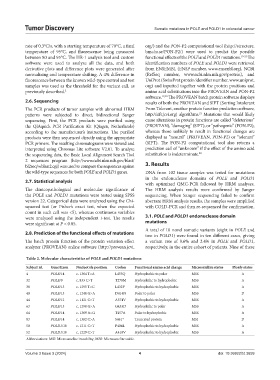
                                                               A total of 10 novel somatic variants (eight in POLE and
            2.8. Prediction of the functional effects of mutations  two in POLD1) were found in ten different cases, giving
            The batch protein function of the protein variation effect   a variant rate of 9.6% and 2.4% in  POLE and  POLD1,
            analyzer (PROVEAN) online software (http://provean.jcvi.  respectively, in the entire cohort of patients. Nine of these

            Table 2. Molecular characteristics of POLE and POLD1 mutations
            Subject id.  Gene/Exon  Nucleotide position  Codon  Functional amino acid change  Microsatellite status  Ploidy status
            4          POLE/14   c. 1364 T>A      L455Q   Hydrophobic to polar     MSS                  A
            32         POLE/9    c. 833 C>T       T278M   Hydrophilic to hydrophobic  MSS               A
            38         POLE/13   c. 1295 T>C      L432P   Hydrophobic to hydrophobic  MSS               A
            40         POLE/13   c. 1240 G>A      D414N   Polar to polar           MSS                  D
            44         POLE/12   c. 1121 C>T      A374V   Hydrophobic to hydrophobic  MSS               A
            63         POLE/13   c. 1298 G>A      G433D   Hydrophilic to polar     MSS                  A
            64         POLE/14   c. 1369 A>G      T457A   Polar to hydrophobic     MSS                  A
            83         POLE/14   c. 1382 C>A      S461*   Truncated protein        MSI                  D
            50         POLD1/10  c. 1211 C>T      P404L   Hydrophobic to hydrophobic  MSS               A
            52         POLD1/10  c. 1229 C>T      A410V   Hydrophobic to hydrophobic  MSS               A
            Abbreviations: MSI: Microsattelite instability; MSS: Microsattelite stable.


            Volume 3 Issue 3 (2024)                         4                                 doi: 10.36922/td.3659

