


Page 53 - TD-3-3
P. 53
Tumor Discovery                                        Somatic mutations in POLE and POLD1 in colorectal cancer


            variants  were  non-synonymous  variants,  which  resulted   No recurrent mutations or double heterozygous mutations
            in amino acid substitutions in the endonuclease domains   were identified among the new  POLE/POLD1 alterations.
            of POLE and POLD1. One mutation in the POLE resulted   Furthermore,  the  previously  described  germline  POLE
            in a stop codon, which is predicted to result in pol  ɛ   L424D or POLD1 S478N mutations were not detected in our
                                                                                      22
            translation termination. With the exception of the POLE   cohort. In our previous study,  we performed NGS analysis
            D414N variants, all the other variants in POLE and POLD1   on the same cohort of samples that was used here. Based on
            were found in the primary tumors (Table 2). However, no   our findings, only four out of ten samples with mutations
            variant was found in the corresponding normal tissues of   in the POLE and POLD1 genes exhibited a hypermutated
            these cases, thereby confirming that these novel alterations   phenotype. These samples were more likely to have a full
            were somatic mutations rather than germline SNPs. Sanger   complement of mutations in APC, KRAS, SMAD4, and
            sequencing  data  also  validated  the  novel  alterations  as   TP53. In contrast, the remaining six out of ten samples were
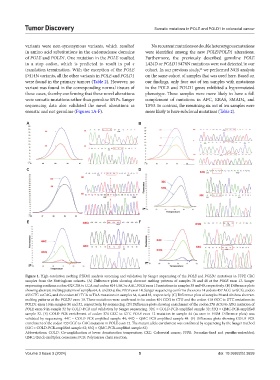
            somatic and not germline (Figures 1A-F).           more likely to have subclonal mutations (Table 2).

            A                                               B


            C                                               D


            E                                               F


            Figure 1. High-resolution melting (HRM) analysis screening and validation by Sanger sequencing of the POLE and POLD1 mutations in FFPE CRC
            samples from the Nottingham cohorts. (A) Difference plots showing aberrant melting patterns of samples 38 and 40 at the  POLE exon 13. Sanger
            sequencing confirms codon 432 CTA to CCA and codon 414 GAC to AAC POLE exon 13 mutations in samples 38 and 40, respectively. (B) Difference plots
            showing aberrant melting patterns of samples 64, 4, and 83 at the POLE exon 14. Sanger sequencing confirms the exons 14 codons 457 ACG to GCG, codon
            455 CTG to CAG, and the codon 461 TCA to TAA mutations in samples 64, 4, and 83, respectively. (C) Difference plots of samples 38 and 40 show aberrant
            melting patterns at the POLD1 exon 10. These mutations were confirmed to be codon 404 CCG to CTG and the codon 410 GCC to GTC mutations in
            POLD1 exon 10 in samples 50 and 52, respectively, by sequencing. (D) Difference plots showing enrichment of the codon 278 ACG to ATG mutation of
            POLE exon 9 in sample 32 by COLD-PCR and validation by Sanger sequencing. 32C = COLD-PCR-amplified sample 32; 32Q = QMC-PCR-amplified
            sample 32. (E)  COLD-PCR enrichment of codon 374 GCC to GTC  POLE  exon 12 mutation in sample 44 (as seen in HRM Difference plots) was
            validated by sequencing. 44C = COLD-PCR-amplified sample 44; 44Q = QMC PCR-amplified sample 44. (F) Difference plots showing COLD-PCR
            enrichment of the codon 433 GGC to GAC mutation in POLE exon 13. The mutant allele enrichment was confirmed by sequencing by the Sanger method
            (63C = COLD-PCR-amplified sample 63; 63Q = QMC-PCR-amplified sample 63)
            Abbreviations: COLD: Co-amplification at lower denaturation temperature; CRC: Colorectal cancer; FFPE: Formalin-fixed and paraffin-embedded;
            QMC: Quick-multiplex consensus; PCR: Polymerase chain reaction.


            Volume 3 Issue 3 (2024)                         5                                 doi: 10.36922/td.3659

