


Page 54 - TD-3-3
P. 54
Tumor Discovery                                        Somatic mutations in POLE and POLD1 in colorectal cancer


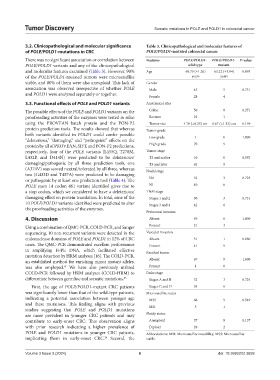
            3.2. Clinicopathological and molecular significance   Table 3. Clinicopathological and molecular features of
            of POLE/POLD1-mutations in CRC                     POLE/POLD1‑mutated colorectal cancer
            There was no significant association or correlation between   Features  POLE/POLD1‑   POLE/POLD1‑   P‑value
            POLE/POLD1 variants and any of the clinicopathological               wild type    mutant
            and molecular features examined (Table 3). However, 90%   Age       69.73 (±1.26)   63.22 (±3.94)   0.093
            of the POLE/POLD1-mutated tumors were microsatellite                   years       years
            stable, and 80% of them were also aneuploid. This lack of   Gender
            association was observed irrespective of whether  POLE   Male          45           5       0.731
            and POLD1 were analyzed separately or together.
                                                                Female             28           4
            3.3. Functional effects of POLE and POLD1 variants  Anatomical sites
            The possible effects of the POLE and POLD1 variants on the   Colon     50           8       0.271
            proofreading activities of the enzymes were tested in silico   Rectum  23           1
            using the PROVEAN batch protein and the PON-P2      Tumor size     4.78 (±0.23) cm  6.67 (±1.33) cm  0.199
            protein prediction tools. The results showed that whereas   Tumor grade
            both variants identified in  POLD1 could confer possible   Low grade    1           0       1.000
            “deleterious,” “damaging,” and “pathogenic” effects on the
            protein by all of PROVEAN, SIFT, and PON-P2 predictions,   High grade  70           9
            respectively, four of the  POLE variants (L455Q, T278M,   Tumor stage
            L432P, and D414N) were predicted to be deleterious/  T2 and earlier    10           0       0.592
            damaging/pathogenic  by all  three prediction tools, one   T3 and later  62         9
            (A374V) was scored neutral/tolerated by all three, whereas   Nodal stage
            two (G433D and T457A) were predicted to be damaging
            or pathogenic by at least one prediction tool (Table 4). The   N0      32           3       0.725
            POLE exon 14 codon 461 variant identified gives rise to   N1           40           6
            a stop codon, which we considered to have a deleterious/  TNM stage
            damaging effect on protein translation. In total, nine of the   Stages 1 and 2  30  3       0.731
            10 POLE/POLD1 variants identified were predicted to alter   Stages 3 and 4  42      6
            the proofreading activities of the enzymes.
                                                               Perineural invasion
            4. Discussion                                       Absent             49           6       1.000

            Using a combination of QMC-PCR, COLD-PCR, and Sanger   Present         21           3
            sequencing, 10 non-recurrent variants were detected in the   Vascular invasion
            endonuclease domains of POLE and POLD1 in 12% of CRC   Absent          31           1       0.080
            cases. The QMC-PCR demonstrated excellent performance   Present        41           9
            in amplifying FFPE DNA, which facilitated effective   Residual tumor
            mutation detection by HRM analyses [16]. The COLD-PCR,
            an established method for enriching minor mutant alleles,   Absent     67           9       1.000
            was also employed.  We have also previously utilized   Present          4           0
                            18
            COLD-PCR followed by HRM analyses (COLD-HRM) to    Duke stage
            differentiate between germline and somatic mutations. 23  Stages A and B  32        3       0.724
              First, the age of  POLE/POLD1-mutant CRC patients   Stages C and D   38           6
            was significantly lower than that of the wild-type patients,   Microsatellite status
            indicating a potential association between younger age   MSS           68           9       0.549
            and these mutations. This finding aligns with previous
            studies  suggesting that  POLE and  POLD1  mutations   MSI              5           1
            are more prevalent in younger CRC patients and may   Ploidy status
            contribute to early-onset CRC. This observation aligns   Aneuploid     37           8       0.137
            with prior research indicating a higher prevalence of   Diploid        29           2
            POLE and  POLD1 mutations in younger CRC patients,   Abbreviations: MSI: Microsatellite instability; MSS: Microsatellite
            implicating them in early-onset CRC.  Second, the   stable.
                                              24

            Volume 3 Issue 3 (2024)                         6                                 doi: 10.36922/td.3659

