


Page 55 - TD-3-3
P. 55
Tumor Discovery                                        Somatic mutations in POLE and POLD1 in colorectal cancer


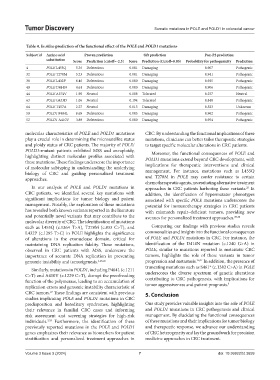
            Table 4. In silico prediction of the functional effect of the POLE and POLD1 mutations
            Subject id  Amino acid   Proven prediction        Sift prediction           Pon‑P2 prediction
                     substitution  Score  Prediction (cutoff=‑2.5)  Score  Prediction (Cutoff=0.05)  Probability for pathogenicity  Prediction
            4        POLE L455Q  −5.36  Deleterious     0.001  Damaging                 0.907        Pathogenic
            32       POLE T278M  −5.23  Deleterious     0.001  Damaging                 0.941        Pathogenic
            38       POLE L432P  −6.46  Deleterious     0.000  Damaging                 0.925        Pathogenic
            40       POLE D414N  −4.61  Deleterious     0.000  Damaging                 0.906        Pathogenic
            44       POLE A374V  −1.95  Neutral         0.088  Tolerated                0.257        Neutral
            63       POLE G433D  −1.06  Neutral         0.194  Tolerated                0.848        Pathogenic
            64       POLE T457A  −2.27  Neutral         0.013  Damaging                 0.523        Unknown
            50       POLD1 P404L  −8.65  Deleterious    0.005  Damaging                 0.962        Pathogenic
            52       POLD1 A410V  −3.89  Deleterious    0.000  Damaging                 0.954        Pathogenic


            molecular characteristics of POLE and POLD1 mutations   CRC. By understanding the functional implications of these
            play a crucial role in determining the microsatellite status   mutations, clinicians can better tailor therapeutic strategies
            and ploidy status of CRC patients. The majority of POLE/  to target specific molecular alterations in CRC patients.
            POLD1-mutant patients exhibited MSS and aneuploidy,   Moreover, the functional consequences of  POLE and
            highlighting distinct molecular profiles associated with
            these mutations. These findings underscore the importance   POLD1 mutations extend beyond CRC development, with
                                                               implications for therapeutic interventions and clinical
            of molecular subtyping in understanding the underlying   management. For instance, mutations such as L455Q
            biology of CRC and guiding personalized treatment
            approaches.                                        and T278M in  POLE may confer resistance to certain
                                                               chemotherapeutic agents, necessitating alternative treatment
              In our analysis of  POLE and  POLD1 mutations in   approaches in CRC patients harboring these variants.  In
                                                                                                          25
            CRC patients, we identified several key mutations with   addition, the identification of hypermutator phenotypes
            significant implications for tumor biology and patient   associated with specific POLE mutations underscores  the
            management. Notably, the exploration of these mutations   potential for immunotherapy strategies in CRC patients
            has revealed both known variants reported in the literature   with mismatch repair–deficient tumors, providing new
            and potentially novel variants that may contribute to the   avenues for personalized treatment approaches. 29,30
            molecular diversity of CRC. The identification of mutations
            such as L455Q (c.1364 T>A), T278M (c.833 C>T), and   Comparing our findings with previous studies reveals
            L432P (c.1295 T>C) in POLE highlights the significance   commonalities and insights into the functional consequences
            of alterations in the exonuclease domain, critical for   of POLE and POLD1 mutations in CRC. For instance, the
            maintaining DNA replication fidelity. These mutations,   identification  of  the  D414N  mutation  (c.1240  G>A)  in
            observed  in  CRC  patients  with  MSS,  underscore  the   POLE, similar to mutations reported in metastatic CRC
            importance of accurate DNA replication in preventing   tumors, highlights the role of these variants in tumor
            genomic instability and tumorigenesis. 1,25,26     progression and metastasis. 26,31  In addition, the presence of
                                                               truncating mutations such as S461* (c.1382 C>A) in POLE
              Similarly, mutations in POLD1, including P404L (c.1211
            C>T) and A410V (c.1229 C>T), disrupt the proofreading   underscores the diverse spectrum of genetic alterations
            function of the polymerase, leading to an accumulation of   contributing to CRC pathogenesis, with implications for
                                                                                                  3
            replication errors and genomic instability characteristic of   tumor aggressiveness and patient prognosis.
                      27
            CRC tumors.  These findings are consistent with previous   5. Conclusion
            studies implicating POLE and POLD1 mutations in CRC
            predisposition and hereditary syndromes, highlighting   Our study provides valuable insights into the role of POLE
            their  relevance  in  familial  CRC  cases  and  informing   and POLD1 mutations in CRC pathogenesis and clinical
            risk  assessment  and screening strategies  for high-risk   management. By elucidating the functional consequences
            individuals.  Furthermore, the identification of these   of these mutations and their implications for tumor biology
                     3,28
            previously reported mutations in the  POLE and  POLD1   and therapeutic response, we advance our understanding
            genes emphasizes their relevance as biomarkers for patient   of CRC heterogeneity and lay the groundwork for precision
            stratification and personalized treatment approaches in   medicine approaches in CRC treatment.


            Volume 3 Issue 3 (2024)                         7                                 doi: 10.36922/td.3659

