


Page 104 - TD-3-4
P. 104
Tumor Discovery                                                   Bioinformatics insights into CCL2 mutations


            complexes were prepared for MD simulations using the   of CCL2 proteins – indicators to classify protein residues –
            GROMOS 43a1 force field.  RMSD measures the average   as well as changes in secondary structures between native
                                 65
            distance between the atoms of two superimposed molecular   and mutant CCL2 proteins. 66
            structures. It is commonly used in bioinformatics to assess
            the similarity of 3D structures, particularly in the study   2.10. Docking of CCL2-native and -mutant proteins
            of protein conformations.  RMSD is calculated using the   with receptor CCR2
                                 61
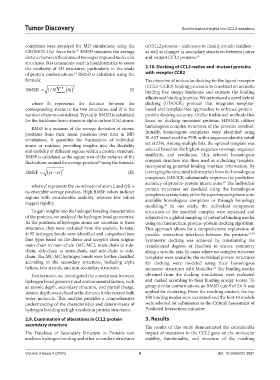
            formula:                                           The objective of molecular docking for the ligand–receptor
            RMSD  = 1/ N  ∑ i n =1 () iδ  2             (I)    (CCL2–CCR2) binding process is to construct an accurate
                                                               binding free energy landscape and estimate the binding
                                                               affinity and binding kinetics. We introduced a novel hybrid
              where  δi represents the distance between the    docking  (HDOCK)  protocol  that  integrates  template-
            corresponding atoms in the two structures, and N is the   based and template-free approaches to enhance protein–
            number of atoms considered. Typically, RMSD is calculated   protein docking accuracy. Unlike traditional methods that
            for the backbone heavy atoms or alpha carbon (Cα) atoms.  focus on docking monomer proteins, HDOCK utilizes
              RMSF is a measure of the average deviation of atomic   homologous complex structures of the proteins involved.
            positions from their mean positions over time in MD   Initially, homologous complexes were identified using
            simulations. It quantifies the fluctuations of individual   BLAST searches of the PDB, with a sequence identity cutoff
            atoms or residues, providing insights into the flexibility   set at 25%. Among multiple hits, the optimal template was
            and mobility of different regions within a protein structure.   selected based on the highest sequence coverage, sequence
            RMSF is calculated as the square root of the variance of the   similarity,  and  resolution.  This  selected  homologous
            fluctuations around the average position  using the formula:  complex structure was then used as a docking template,
                                           62
                                                               incorporating potential binding interface information. By
            RMSF  = (γi − ) i  2                       (II)    leveraging the structural information from the homologous
                         γ
                                                               complexes, HDOCK substantially improves the prediction
                                                               accuracy of protein–protein interactions.  The individual
                                                                                                67
              where γi represents the coordinates of atom i, and 〈γi〉 is
            its ensemble average position. High RMSF values indicate   protein structures are modeled using the homologous
                                                               complexes as templates, either by superimposing them onto
            regions with considerable mobility, whereas low values   available homologous complexes or through homology
            suggest rigidity.
                                                               modeling.  In our study, the individual component
                                                                       68
              To gain insights into the hydrogen bonding characteristics   structures of the modeled complex were separated and
            of the proteins, we analyzed the hydrogen bond geometries.   subjected to a global sampling of potential binding modes
            As the positions of hydrogen atoms are uncertain in these   using our hierarchical protein–protein docking algorithm.
            structures, they were excluded from the analysis. In total,   This approach allows for a comprehensive exploration of
            4195 hydrogen bonds were identified and categorized into   possible interaction interfaces  between the proteins. 69,70
            four types based on the donor and acceptor atom origins:   Symmetric docking was achieved by constraining the
            main-chain to main-chain (MC-MC), main-chain to side-  translational degrees of freedom to ensure symmetry
            chain,  side-chain  to  main-chain,  and  side-chain  to  side-  along a specific axis. In cases where no complex structure
            chain. The MC-MC hydrogen bonds were further classified   templates were available, the individual protein structures
            according to the secondary structures, including alpha   for docking were modeled using their homologous
            helices, beta strands, and non-secondary structures.  monomer structures with Modeller.  The binding modes
                                                                                            71
              Furthermore, we investigated the correlations between   obtained from the docking simulations were evaluated
            hydrogen bond geometry and environmental factors, such   and ranked according to their binding energy scores. To
            as atomic depth, secondary structure, and partial charge.   group similar conformations, an RMSD cutoff of 5.0 Å was
            Atomic depth was defined as the distance to the nearest bulk   applied for clustering. From the resulting clusters, the top
            water  molecule. This  analysis  provides  a comprehensive   100 binding modes were examined and the best 10 models
            understanding of the characteristics and determinants of   were selected for submission to the Critical Assessment of
            hydrogen bonding in high-resolution protein structures.  Predicted Interactions initiative.
            2.9. Examination of alterations in CCL2 protein    3. Results
            secondary structure                                The results of this study demonstrated the considerable
            The Database of Secondary Structure in Proteins tool   impact of mutations in the CCL2 gene on the molecular
            analyzes hydrogen bonding and other secondary structures   stability, functionality, and structure of the resulting


            Volume 3 Issue 4 (2024)                         6                                 doi: 10.36922/td.3891

