


Page 51 - TD-3-4
P. 51
Tumor Discovery                                                                PPAR agonist and cancer


            the ROS scavenger N-acetylcysteine inhibited ROS   levels and its transcriptional activity in ovarian cancer
            production and the apoptotic cell death induced by this   cells. 91
            combination treatment.  The synergistic treatment of   Combination therapy using tumor necrosis factor-
                               87
            TGZ and heregulin increased the generation of superoxide   related  apoptosis-inducing  ligand  (TRAIL)  with  PPAR
            in mitochondria, which disrupted mitochondrial potential   ligands may offer a promising experimental approach, as
            and induced substantial cell death in breast cancer cells. 88  PPAR ligands – particularly d15-PGJ2 – sensitize drug-
                                                                                                            92
            4.5. PPAR agonists for suppression of multidrug    resistant ovarian cancer cells to TRAIL-induced apoptosis.
            resistance (MDR)                                   In general, Wnt/β-catenin signaling is upregulated during
                                                               inflammatory processes  and oxidative stress  in many
            MDR is an acquired resistance that poses a major barrier to   cancers, whereas PPAR-γ is typically downregulated in
            the successful treatment of cancer. One of the most common   these  contexts.  Therefore,  PPAR-γ  ligands  have  been
            causes of MDR is the overexpression of P-glycoprotein   shown to prevent cancer development by modulating the
            (P-gp),  which  is  encoded  by  the  MDR1  gene.  This  gene   Wnt/β-catenin signaling pathway. 93
            is a direct target of the Wnt/β-catenin signaling pathway,
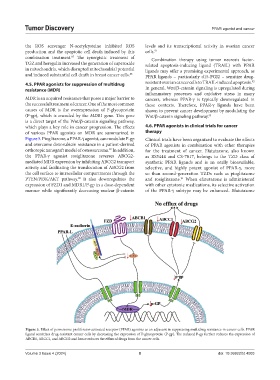
            which plays a key role in cancer progression. The effects   4.6. PPAR agonists in clinical trials for cancer
            of various PPAR agonists on MDR are summarized in   therapy
            Figure 5. Pioglitazone, a PPAR-γ agonist, can modulate P-gp   Clinical trials have been organized to evaluate the effects
            and overcome doxorubicin resistance in a patient-derived   of PPAR agonists in combination with other therapies
            orthotopic xenograft model of osteosarcoma.  In addition,   for the treatment of cancer. Efatutazone, also known
                                               89
            the PPAR-γ agonist rosiglitazone reverses ABCG2-   as RS5444 and CS-7017, belongs to the TZD class of
            mediated MDR expression by inhibiting ABCG2 transport   synthetic PPAR ligands and is an orally bioavailable,
            activity and facilitating the translocation of ABCG2 from   selective, and highly potent agonist of PPAR-γ, more
            the cell surface to intracellular compartments through the   so than second-generation TZDs such as pioglitazone
            PTEN/PI3K/AKT pathway.  It also downregulates the   and rosiglitazone.  When efatutazone is administered
                                                                              94
                                  90
            expression of FZD1 and MDR1/P-gp in a dose-dependent   with other cytotoxic medications, its selective activation
            manner  while  significantly  decreasing  nuclear  β-catenin   of the PPAR-γ subtype may be enhanced. Efatutazone


            Figure 5. Effect of peroxisome proliferator-activated receptor (PPAR) agonists as an adjuvant in suppressing multidrug resistance in cancer cells. PPAR
            ligand sensitizes drug-resistant cancer cells by decreasing the expression of P-glycoprotein (P-gp). The reduced P-gp further reduces the expression of
            ABCB1, ABCC1, and ABCG2 and hence reduces the efflux of drugs from the cancer cells.


            Volume 3 Issue 4 (2024)                         8                                 doi: 10.36922/td.4003

