


Page 66 - TD-3-4
P. 66
Tumor Discovery                                                  RNA-protein complexes deregulated in cancer


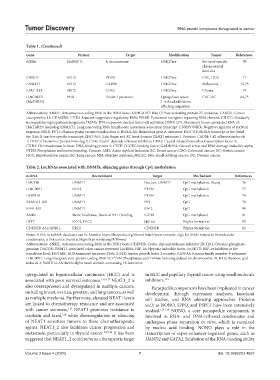
            Table 1. (Continued)
            Gene                  Partner             Target             Modification      Tumor     References
            FIRRE            HnRNP U          X chromosome           H3K27me           Set up of specific   70
                                                                                       chromosomal
                                                                                       domains
            CASC11           EZH2             PTEN                   H3K27me           CRC, HCC         71
            LNMAT1           EZH2             CADM                   H3K27me           Melanoma        72,73
            ZFAT-AS1         PRC2             CDX2                   H3K27me           Glioma           74
            LINC01271        PUB              Tensin 1 promoter      Upregulates tensin   CRC, BC      64,75
            (MaTAR25)                                                1 in focal adhesions,
                                                                     affecting migration
            Abbreviations: ANRIL: Antisense noncoding RNA in the INK4 locus; ARHGAP27: Rho GTPase activating protein 27, antisense. CASC11: Cancer
            susceptibility 11; CHASERR: CHD2 Adjacent suppressive regulatory RNA; FIRRE: Functional intergenic repeating RNA element; GIHCG: Gradually
            increased during hepatocarcinogenesis; IRENA: IFN-responsive nuclear factor-κB activator; LINC01271: Mammary tumor associated RNA 25
            (MaTAR25) homolog; LNMAT1: Long noncoding RNA lymph node metastasis-associated transcript 1; NRAV/NRIR: Negative regulator of antiviral
            response; NRIR: PVT1: Plasmacytoma variant translocation 1; HOXA-AS: Homeobox gene A, antisense; HOTTIP: HOXA transcript at the distal
            tip; Xist: X-inactive specific transcript; ZFAT-AS1: Zinc finger and AT hook domain (ZFAT) antisense 1. Proteins. CADM: Cell adhesion molecule
            1; CBX7: Chromobox protein homolog 7; CDKi: Cyclin-dependent kinase inhibitor; CDX2: Caudal-related homeobox transcription factor 2;
            CHD2: Chromodomain helicase DNA-binding protein 2; CTCF: CCCTC-binding factor; GADD45A: Growth arrest and DNA damage-inducible alpha;
            PTEN: Phosphatase and tensin homolog. Cancers. AML: Acute myeloid leukemia; BC: Breast cancer; CRC: Colorectal cancer; GC: Gastric cancer;
            HCC: Hepatocellular cancer; LC: Lung cancer; MM: Multiple myeloma; NSCLC: Non-small cell lung cancer; OC: Ovarian cancer.

            Table 2. LncRNAs associated with DNMTs, silencing genes through CpG methylation
            ncRNA                       Recruitment               Target           Mechanism         References
            DACOR               DNMT1                         Fos, Jun, DNMT1  CpG methylation, Decoy   76
            LINC0051            EZH2                          PTEN             CpG methylation          77
            HOTAIR              DNMT1                         PTEN             CpG methylation          78
            SAMD12-AS1          DNMT1                         P53              CpG                      79
            KIF9-AS1            DNMT1                         RAI2             CpG                      80
            ANRIL               Steric hindrance, block of Pol II binding  IGF2R  CpG methylated        81
            HITT                EZH2, PRC2                    Hif-1α           Triplex formation        82
            CDKN2B-AS1/ANRIL    PRC2                          CDKN2B           Triplex formation        83
            Notes: A link to ncRNA databases can be found at https://lncipedia.org/db and http://www.noncode.org/; for RNAs related to biomolecular
            condensates, a link can be found at https://rps.renlab.org/#/Browse
            Abbreviations: ANRIL: Antisense noncoding RNA in the INK4 locus; CDKN2B: Cyclin-dependent kinase inhibitor 2B; CpG: Cytosine-phosphate-
            guanine; DACOR: DNMT1-associated colon cancer repressed LncRNA; HIF-1α: Hypoxia inducible factor 1α; HITT: HIF-1α inhibitor at the
            translation level; HOTAIR: HOX transcript antisense RNA; IGF2R: Insulin growth factor 2 receptor; KIF9-AS: Kinesin family member 9-antisense;
            LINC0051: Long intergenic non-protein coding RNA 51; PTEN: Phosphatase and TENsin homolog deleted on chromosome 10; RAI2: Retinoic acid
            induced 2; SAMD12-AS: Sterile alpha motif domain-containing 12-Antisense.

            upregulated in hepatocellular carcinoma (HCC) and is   in HCC and papillary thyroid cancer using small molecule
            associated with poor survival outcomes. 111-117  NEAT1_2 is   inhibitors. 121
            also overexpressed and dysregulated in multiple cancers,   Paraspeckle components have been implicated in cancer
            including breast, ovarian, prostate, and lung cancers, as well   development through expression analyses, knockout
            as multiple myeloma. Furthermore, elevated NEAT1 levels   cell studies, and RNA silencing approaches. Proteins
            are linked to chemotherapy resistance and are associated   such as NONO, SFPQ, and PSPC1 have been extensively
            with cancer stemness.  NEAT1 promotes resistance to   studied. 122-129  NONO, a core paraspeckle component, is
                              117
            cisplatin and taxol,  while downregulation or silencing   involved in RNA-  and DNA-tethered condensates and
                            118
            of NEAT1 sensitizes tumors to these chemotherapeutic   undergoes phase separation  in vitro, which is sustained
            agents. NEAT1_2 also facilitates cancer progression and   by nucleic acid binding. NONO plays a role in the
            metastasis, particularly in thyroid cancer. 119,120  It has been   transcription of super-enhancer-regulated genes, such as
            suggested that NEAT1_2 could serve as a therapeutic target   HAND2 and GATA2. Inhibition of the RNA-binding ability


            Volume 3 Issue 4 (2024)                         7                                 doi: 10.36922/td.4657

