


Page 69 - AC-2-2
P. 69
Arts & Communication                                                      Japanese children’s musical flow


            the  conventional  flow  research  has  focused  on  adult   we designed to provide the participants with experiences
            professionals, Csikszentmihalyi described that children are   of interacting with both technological and traditional
            naturally in flow. 2                               musical instruments, as well as metallic objects producing
              In the realm of music education research, flow research,   ringing tones.
            which originated in preschool children’s music making,   2.2. Settings
            has  expanded  to include school-aged  children,  middle
            school beginner string orchestras, beginner adult singers,   2.2.1. Technology
            and community music learning settings.  These studies   Professor Yutaka Nakanishi of Shujitsu University installed
                                             3-8
            employed flow indicators in  musical activities  (FIMA),   Ableton Live 9 Lite digital audio workstation software on
            devised by Dr.  Lori Custodero of Teachers College,   his  laptop.   He  then  imported  sound  effects  and  drum
                                                                       11
            Columbia University, as a reliable tool to assess children’s   loops into Live 9 Lite and connected Novation’s Launchpad
            flow during musical activities.  In addition, Akutsu’s study   Pro grid controller to the laptop.  This grid controller, also
                                                                                        11
                                    9
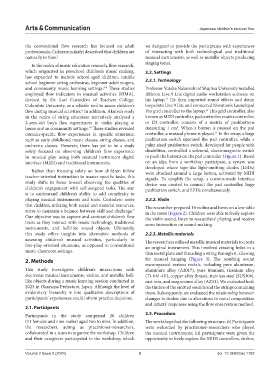
            in the realm of string education narratively analyzed a   known as MIDI controller, pad controller, matrix controller,
            2-year-old boy’s flow experiences in violin playing at   or DJ controller, consists of a matrix of pushbuttons
            home and in community settings.  These studies revealed   measuring 1 cm . When a button is pressed on the pad
                                                                            2
                                       10
                                                                                            11
            domain-specific  flow  experiences  in  specific  situations,   controller, a musical phrase is played.  In the setup, a large
            such as early childhood music classes, string classes, and   pushbutton switch operated the pad controller, while a
            orchestra classes. However, there has yet to be a study   palm-sized pushbutton switch, developed for people with
            solely focused on observing children’s flow experience   disabilities, controlled a solenoid, electromagnetic switch
            in  musical  play  using  both  musical  instrument  digital   to push the buttons on the pad controller (Figure 1). Based
            interface (MIDI) and traditional instruments.      on  an  idea  from  a  workshop  participant,  a  system  was
                                                               developed where tape-like light-emitting diodes (LEDs)
              Rather than focusing solely on how children follow   were attached around a large button, activated by MIDI
            teacher-oriented instruction to master specific tasks, this   signals. To simplify the setup, a custom-made interface
            study shifts its focus toward observing the qualities of   device was created to connect the pad controller, large
            children’s  engagement with  self-assigned  tasks.  The aim   pushbutton switch, and LEDs simultaneously.
            is to understand children’s ability to add complexity to
            playing musical instruments and tools. Custodero notes   2.2.2. Violin
            that children, utilizing both social and material resources,   The researcher prepared 10 violins and bows on a low table
            strive to maintain a balance between skill and challenge.    in the room (Figure 2). Children were able to freely explore
                                                          9
            Our objective was to capture and contrast children’s flow   the violin sound, listen to researchers’ playing, and receive
            traits as they interact with music technology, traditional   some instruction on sound-making.
            instruments, and bell-like sound objects. Ultimately,
            this study offers insights into alternative methods of   2.2.3. Metallic materials
            assessing  children’s  musical  activities,  particularly  in   The researchers utilized metallic musical materials to create
            free-play-oriented situations, as opposed to conventional   an original instrument. This involved creating holes in a
            music classroom settings.                          thin metal plate and threading a string through it, allowing
            2. Methods                                         for  manual  hanging  (Figure  3).  The  resulting  sound
                                                               encompassed various metals, including pure aluminum,
            This study investigates children’s interactions with   aluminum alloy (A2017), pure titanium, titanium alloy
            electronic musical instruments, violins, and metallic bell-  (Ti-6Al-4V), copper alloy (brass), stainless steel (SUS304),
            like objects during a music learning session conducted in   cast iron, and magnesium alloy (AZ31). We evaluated both
            2023 in Okayama Prefecture, Japan. Although the level of   the timbre of the emitted sounds and the strings containing
            evidentiary hierarchy is low, qualitative descriptions of   them. Subsequently, we evaluated the relationship between
            participants’ experiences could inform practice decisions.  changes in timbre due to alterations in metal composition
                                                               and infants’ responses using the flow observation method.
            2.1. Participants
            Participants in the study comprised 20 children    2.3. Procedure
            (11 females and nine males) aged two to nine. In addition,   The workshops had the following structure: (i) Participants
            the researchers, acting as practitioner-researchers,   were welcomed by practitioner-researchers who played
            collaborated in a team to organize the workshop. Children   the musical instruments; (ii) participants were given the
            and their caregivers participated in the workshop, which   opportunity to freely explore the MIDI controllers, violins,


            Volume 2 Issue 2 (2024)                         2                                doi: 10.36922/ac.1782

