


Page 45 - AIH-1-2
P. 45
Artificial Intelligence in Health                                        Blockchain for health-care security


            Table 5. List of the characteristics of blockchain technology and their descriptions
            Characteristics Description
            Decentralization • Blockchain technology is a serialized data structure used to establish a decentralized ledger.
                        • Decentralization allows parties to transact data in the health-care sector without involving a third party, reducing financial bias and fraud.
            Trustlessness  Payments are made only when the balance is available on the blockchain, a feature that is essential to secure financial balances.
            User-centricity  • The user-centricity attribute of blockchain technology ensures patients in control of their personal financial data.
                        • Blockchain allows the patient to become the key mediator in distributing his or her medical data.
                        •  Patient or family member must expressly grant the provider access to the patient’s medical record governed by the patient’s private
                         key signature for every new medical interaction.
                        •  Every access to patient’s data is recorded in the immutable transaction history of the blockchain, providing a clear record of who has
                         accessed and edited the patient’s record.
            Transparency  • Every transaction data in the blockchain is publicly viewable.
            Immutability  • Blockchain is impervious to data manipulation.
                        • The immutability of the blockchain ledger means that transactions cannot be changed or removed once they have been recorded.
                        • Blockchains serve as a data timekeeping system, allowing easy data history reporting.
            Speed       • Blockchain technology helps enhance the efficiency of verification for health‑care sector transactions between financial institutions.
            Cost        • Blockchain technology obviates the need to pay transaction fees by removing intermediaries from the health‑care transaction.


                                                               applications. 18,44  There are other applications that have used
                                                               blockchain technology in the field of health care, which are
                                                               explained in the following subsections.

                                                               8.1. Blockchain for health-care management
                                                               Blockchain technology carves out a revolutionary niche
                                                               in the health management sector due to the advances and
                                                               benefits it brings to cloud storage of EHR data, privacy
                                                               protection,  etc., as shown in  Figure  6. With blockchain,
                                                               we can improve data sharing, management, and storage.
                                                               Data can then be easily shared with health-care providers.
                                                               The steps of how blockchain could be used in health-care
                                                                                              32
                                                               domain summarized by Khezr  et al.  are given in the
                                                               following:
                                                               (i)  Step 1: While interacting with the doctors, the recent
                                                                  information about the patient are integrated into the
                                                                  medical records, serving as the primary data.
                                                               (ii)  Step 2: EHR of the patient is shaped using the primary
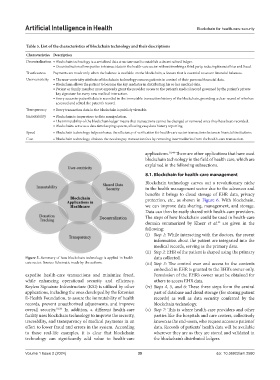
            Figure 5. Summary of how blockchain technology is applied in health-  data collected.
            care sector. Source: Schematic made by the authors.  (iii) Step 3:  The  control  over  and  access  to  the  contents
                                                                  embodied in EHR is granted to the EHR’s owner only.
            expedite health-care transactions and minimize fraud,   Permission of the EHR’s owner must be obtained for
            while  enhancing  operational  security  and  efficiency.   others to access EHR data.
            Keyless Signature Infrastructure (KSI) is utilized by other   (iv)  Steps 4, 5, and 6: These three steps form the central
            applications, including the ones developed by the Estonian   part of database and cloud storage (for storing patient
            E-Health Foundation, to assure the immutability of health   records) as well as data security conferred by the
            records, prevent unauthorized adjustments, and improve   blockchain technology.
            overall  security. 18,36   In  addition,  a  different  health-care   (v)  Step 7: This is where health-care providers and other
            facility uses blockchain technology to improve the security,   parties like the hospitals and care centers, collectively
            traceability, and transparency of medical payments in an   known as the end-users, who request access to patients’
            effort to lower fraud and errors in the system. According   data. Records of patients’ health data will be available
            to these real-life examples, it is clear that blockchain   wherever they are as they are stored and validated in
            technology can significantly add value to health-care   the blockchain’s distributed ledgers.


            Volume 1 Issue 2 (2024)                         39                               doi: 10.36922/aih.2580

