


Page 60 - AIH-1-2
P. 60
Artificial Intelligence in Health                                       AI in AD – Diagnosis and monitoring


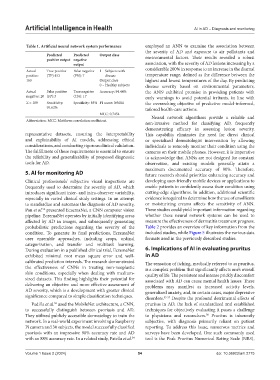
            Table 1. Artificial neural network system performance  employed an ANN to examine the association between
                                                               the severity of AD and exposure to air pollutants and
                     Predicted   Predicted   Output class      environmental factors. Their results revealed a robust
                     positive output negative
                                output                         association, with the severity of AD lesions increasing by a
            Actual   True positive   False negative   1 –  Subjects with   considerable 200% in response to an increase in the diurnal
            positive:   (TP):153  (FN): 7     disease          temperature range, defined as the difference between the
            160                            Output class        highest and lowest temperatures of the day. By predicting
                                           0 – Healthy subjects  disease severity based on environmental parameters,
            Actual   False positive   True negative   Accuracy: 94.44%  the ANN exhibited promise in providing patients with
            negative: 20 (FP):3  (TN): 17                      early warnings to avoid potential irritants, in line with
            Σ = 180  Sensitivity:   Specificity: 85% F1 score: 0.9684  the overarching objective of predictive model-informed,
                     95.62%                                    tailored health-care actions.
                                           MCC: 0.7454
            Abbreviation: MCC: Matthews correlation coefficient.  Neural network algorithms provide a reliable and
                                                               non-invasive method for classifying AD, frequently
                                                               demonstrating efficacy in assessing lesion severity.
            representative datasets, ensuring the interpretability   This capability eliminates the need for direct clinical
            and explainability of AI models, addressing ethical   or specialized dermatologist intervention by allowing
            considerations, and conducting rigorous clinical validation.   individuals to remotely monitor their condition using the
            The fulfillment of these requirements is essential to ensure   cameras on their mobile phones. However, it is imperative
            the reliability and generalizability of proposed diagnostic   to acknowledge that ANNs are not designed for constant
            tools for AD.                                      observation, and existing models generally attain a
                                                               maximum documented accuracy of 90%. Therefore,
            5. AI for monitoring AD                            future research should prioritize enhancing accuracy and
            Clinical professionals’ subjective visual inspections are   developing user-friendly mobile devices or applications to
            frequently used to determine the severity of AD, which   enable patients to confidently assess their condition using
            introduces significant inter- and intra-observer variability,   cutting-edge algorithms. In addition, additional scientific
            especially in varied clinical study settings. In an attempt   evidence is required to determine how the use of emollients
            to standardize and automate the diagnosis of AD severity,   or moisturizing creams affects the sensitivity of ANN.
                   52
            Pan et al.  presented EczemaNet, a CNN computer vision   These studies could yield important information regarding
            pipeline. EczemaNet operates by initially identifying areas   whether  these neural  network  systems can be  used to
            affected by AD in images, and subsequently generating   measure the effectiveness of dermatitis treatment progress.
            probabilistic predictions regarding the severity of the   Table 2 provides an overview of key information from the
            condition. To generate its final predictions, EczemaNet   included studies, while Figure 5 illustrates the various data
            uses ensemble approaches, including crops, ordinal   formats used in the previously described studies.
            categorization, and transfer and multitask learning.
            During evaluation in a published clinical trial, EczemaNet   6. Implications of AI in evaluating pruritus
            exhibited minimal root mean square error and well-  in AD
            calibrated prediction intervals. The research demonstrated   The sensation of itching, medically referred to as pruritus,
            the  effectiveness of  CNNs in  treating non-neoplastic   is a complex problem that significantly affects one’s overall
            skin conditions, especially when dealing with medium-  quality of life. The persistent and intense prickly discomfort
            sized datasets. This finding highlights their potential for   associated with AD can cause mental health issues. These
            delivering an objective and more effective assessment of   problems may manifest as increased activity levels,
            AD severity, which is a development with greater clinical   generalized anxiety, and, in certain cases, major depressive
            significance compared to simple classification techniques.  disorders. 55-57  Despite the profound detrimental effects of
              Padilla et al.  used the MobileNet architecture, a CNN,   pruritus in AD, the lack of standardized and established
                        53
            to successfully distinguish between psoriasis and AD.   techniques for objectively evaluating it poses a challenge
            They utilized publicly accessible dermatology to train the   to physicians and researchers.  Pruritus is inherently
                                                                                         58
            network. In a real-world experiment involving a Raspberry   subjective, with  diagnosis  primarily reliant on patient
            Pi camera and 30 subjects, the model successfully classified   reporting.  To  address  this  issue,  numerous  metrics  and
            psoriasis with an  impressive  90%  accuracy rate  and  AD   surveys have been developed. One such commonly used
            with an 88% accuracy rate. In a related study, Patella et al. 54   tool is the Peak Pruritus Numerical Rating Scale (NRS),


            Volume 1 Issue 2 (2024)                         54                               doi: 10.36922/aih.2775

