


Page 84 - AIH-1-2
P. 84
Artificial Intelligence in Health                               Combating XDR-bacteria as we approach 2050


            Instead, we emphasized peptide antibiotics, which are   extracted with pure ethanol and centrifuged at 10,000 rpm
            novel in their preparation and mode of action. 17  for 10 min to obtain a clear solution which was then dried
                                                               at room temperature.
            2. Materials and methods
                                                               2.4. Biochemical and molecular biological assays
            2.1. PubMed and database search
                                                               The  methyl  red  assay  principle  is  based  on  mixed  acid
            We conducted a search on PubMed (www.ncbi.nlm.nih.  fermentation (acetic, lactic, and succinic) by certain
            gov/pubmed) using the following terms: “MDR bacteria,”   bacteria, resulting in a significant pH decrease in the
            “nisin,” “salivaricin,” “phyto-drugs,” “herbal drugs,” and   medium, dropping below 4.4. This pH change is indicated by
            “MDR plasmids.”                                    a color change of the pH indicator, methyl red (2-dimethyl-

            2.2. Isolation of multi-drug-resistant bacteria    4-amino azobenzene-O-carboxylic acid), turning from
                                                               yellow when the pH is above 5.1 to red at pH 4.4.
            We isolated MDR bacteria from samples obtained
            from the Ganges River by plating 0.1  mL of water onto   The Voges-Proskauer assay, named after two pioneering
            LB+agar+50  µg/mL ampicillin or other antibiotics.   microbiologists, is used to detect the formation of acetyl
            Following incubation, single colonies were selected   methyl carbinol by bacterial metabolism, a product of the
            and tested for various drug sensitivities using different   butylene glycol pathway. Organisms such as members
            antibiotic-impregnated papers. Plasmids were isolated   of the  Klebsiella-Enterobacter-Hafnia-Serratia group
            using the alkaline lysis method as described in Maniatis   produce acetoin as the chief end product of glucose
            et al.  The polymerase chain reaction (PCR) was conducted   metabolism and form smaller quantities of mixed acids. In
               18
            using a standard PCR kit employing specific forward and   the presence of atmospheric oxygen and 40% potassium
            reverse primers targeting  mdr  genes, including  bla, tet,   hydroxide, acetoin is converted to diacetyl, which is then
            acrA, mcr, and 16s rRNA genes for 30 cycles (95°C for 45 s,   converted into a red complex under the catalytic action of
            52°C for 1 min, and 72°C for 1.5 min). The sequencing of   alpha-naphthol.
            PCR fragments was performed at Xcelris Labs Ltd., India.   Simmons citrate agar serves as an agar medium used
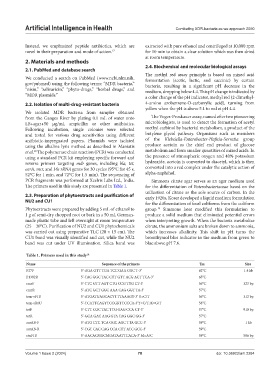
            The primers used in this study are presented in Table 1.  for the differentiation of Enterobacteriaceae based on the
                                                               utilization of citrate as the sole source of carbon. In the
            2.3. Preparation of phytoextracts and purification of   early 1920s, Koser developed a liquid medium formulation
            NU2 and CU1                                        for the differentiation of fecal coliforms from the coliform
            Phytoextracts were prepared by adding 5 mL of ethanol to   group.  Simmons later modified this formulation to
                                                                    19
            1 g of semi-dry chopped root or bark in a 50 mL German-  produce a solid medium that eliminated potential errors
            made plastic tube and left overnight at room temperature   when interpreting growth. When the bacteria metabolize
            (25 – 30°C). Purification of NU2 and CU1 phytochemicals   citrate, the ammonium salts are broken down to ammonia,
            was carried out using preparative TLC (20 × 15 cm). The   which increases alkalinity. This shift in pH turns the
            CU1 band was visually identified and cut, while the NU2   bromthymol blue indicator in the medium from green to
            band was cut under UV illumination. Silica band was   blue above pH 7.6.

            Table 1. Primers used in this study 14
            Name                            Sequence of the primers                   Tm                 Size
            P27F                   5’-AGA GTT TGA TCC GAA CGC T-3’                    62°C               1.4 kb
            P1392R                 5’-TAC GGC TAC CTT GTT ACG ACT TCA-3’              65°C
            cmrF                   5’-TTC GTT AGT CTG CCG TTG CT-3’                   56°C               323 bp
            cmrR                   5’-ATC GCT GGC AAA CAG GGT TA-3’                   57°C
            tem-sF1U               5’-ATGATGAGCACYTTTAAAGT-3’ Y=C/T                   56°C               312 bp
            tem-sR1U               5’-TCATTCAGYTCCGKTTCCCA-3’Y=C/T; K=G/T             58°C
            tetF                   5’-CTT CGC TAC TTG GAG CCA CT-3’                   57°C               910 bp
            tetR                   5’-GCA GAC AAG GTA TAG GGC GG-3’                   57°C
            acrAB-F                5’-ATG CTC TCA GGC AGC TTA GCC-3’                  59°C               1 kb
            acrAB-R                5’-TGT CAC CAG CCA CTT ATC GCC-3’                  59°C
            ctxF1U                 5’-AACACMGCMGATAATTCACA-3’ M=A/C                   59°C               586 bp


            Volume 1 Issue 2 (2024)                         78                               doi: 10.36922/aih.2284

