


Page 89 - AIH-1-2
P. 89
Artificial Intelligence in Health                               Combating XDR-bacteria as we approach 2050


            Table 2. (Continued)
            Accession number  Size (kb)  Multidrug‑resistant marker genes: Drug transporters   GenBank (year)  Pathogenic bacterial name
                                   and antibiotic‑inactivating enzymes
            GU585907         79    aadA2, aphA2, aadA1*, strA, strB, and blaVIM1  2010   K. pneumoniae
            KF954759         73    blaKPC3, strB, aac (6’), and chrB            2014     K. pneumoniae
            KJ460501         62    blaCTX-M                                     2014     S. sonnei
            NZ_CP008901      52    Dhfr, blaKPC-2                               2015     E. cloacae
            AY046276         51    aadA1, blaOXA-2, sul1, tetA, and ABC         2012     S. enterica
            KT225462         50    mphE, sul1, blaDHA-1, qbrB, strA, and strB   2015     K. pneumoniae
            AB61665          47    blaIMP2, aacA4, aadA2, tetA, blaCTX-M, and sul1  2012  K. pneumoniae
            KJ541071         44    sul1, blaOXA-2, aadA/B, blaTEM, catA1, and blaGES-5  2014  E. coli
            JX104759         42    blaKPC-2 and ABC                             2013     K. pneumoniae
            KC354802         41    aacA4, aadA1, blaOXA-9, and blaTEM-1         2013     K. pneumoniae
            NC_021087        26    blaGIM-1, aacA4, aadA1, blaOXA-2, and sul1   2015     E. cloacae
            JN215524         24    Dhfr, cmlA, blaOXA10, aadA1, qnrB, blaDHA1, and sul1  2012  C. freundii
            NG_035843        15    blaOXA-30, catB3, arr-3, sul1, qnr, and blaDHA-1  2014  E. coli
            NG_041456        2.5   blaKPC-2                                     2014     P. aeruginosa
            JN677524         1.9   Ble and blaNDM-1                             2016     K. pneumonia
            Abbreviations: P. aeruginosa: Pseudomonas aeruginosa; K. oxytoca: Klebsiella oxytoca; K. pneumonia: Klebsiella pneumonia; E. coli: Escherichia coli;
            S. enterica: Salmonella enterica; C. freundii: Citrobacter freundii; P. stuartii: Providencia stuartii; E. aerogenes: Klebsiella aerogenes;
            E. cloacae: Enterobacter cloacae; S. marcescens: Serratia marcescens; S. sonnei: Shigella sonnei.


            Figure 4. Detection of blaCTX-M1 genes in the Ganges River water MDR
            bacteria. Among 14 ampicillin-  and tetracycline-resistant bacteria, five
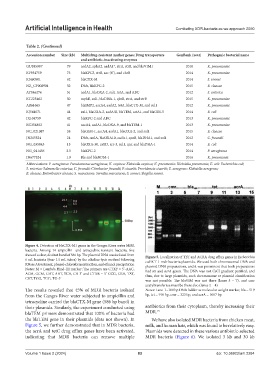
            showed a clear, distinct band of 586 bp. The plasmid DNA was isolated from   Figure 5. Localization of TET and ACRA drug efflux genes in Escherichia
            6 mL bacteria (four 1.5 mL tubes) by the alkaline-lysis method following   coli KT-1_mdr bacteria plasmids. We used both chromosomal DNA and
            RNase A treatment, phenol-chloroform extraction, and ethanol precipitation   plasmid DNA preparations, and it was prominent that both preparations
            Notes: M = Lambda Hind-III marker; The primers are CTXF = 5’-AAC,   had tet and acrA genes. The DNA was not CsCl gradient purified, and
            ACM, GCM, GAT, AAT, TCA, CA-3’ and CTXR = 5’-CCG, CRA, TAT,   thus, due to large plasmids, such chromosome or plasmid classification
            CRT, TGG, TGG, TG-3’
                                                               was not possible. The blaVIM was not there (lanes 5 – 7), and cmr
                                                               acetyltransferase must be there also (lanes 2 – 4)
            The results revealed that 45% of MDR bacteria isolated   Notes: Lane-1=100 bp DNA ladder as molecular weight marker, bla = 519
            from the Ganges River water subjected to ampicillin and   bp, tet = 910 bp, cmr = 323 bp, and acrA = 1007 bp.
            tetracycline carried the blaCTX-M gene (586 bp band) in
            their plasmids. Similarly, the experiment conducted using   antibiotics from their cytoplasm, thereby increasing their
            blaTEM primers demonstrated that 100% of bacteria had   MDR. 15
            the blaTEM gene in their plasmids (data not shown). In   We have also isolated MDR bacteria from chicken meat,
            Figure 5, we further demonstrated that in MDR bacteria,   milk, and human hair, which was found to be relatively easy.
            the acrA and tetC drug efflux genes have been activated,   Plasmids were detected in these various antibiotic-selected
            indicating that MDR bacteria can remove multiple   MDR bacteria (Figure  6). We isolated 3  kb and 30  kb


            Volume 1 Issue 2 (2024)                         83                               doi: 10.36922/aih.2284

