


Page 91 - AIH-1-2
P. 91
Artificial Intelligence in Health                               Combating XDR-bacteria as we approach 2050


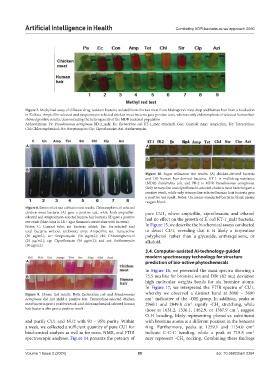
            Figure 7. Methyl red assay of different drug-resistant bacteria isolated from chicken meat from Midnapore’s meat shop and human hair from a local salon
            in Kolkata. Ampicillin-selected and streptomycin-selected chicken meat bacteria gave positive tests, whereas only chloramphenicol-selected human hair
            showed positive results, demonstrating the heterogeneity of the MDR bacterial population
            Abbreviations: Pa:  Pseudomonas aeruginosa  BD-2_mdr; Ec:  Escherichia coli  KT-1_mdr standard; Con: Control; Amp: Ampicillin; Tet: Tetracycline;
            Chl: Chloramphenicol; Str: Streptomycin; Cip: Ciprofloxacin; Azi: Azithromycin.


            A                                                  A


                                                               B
            B
                                                               Figure  10. Sugar  utilization  test results.  (A) chicken-derived bacteria
                                                               and (B) human hair-derived bacteria. KT-1 is multidrug-resistance
                                                               (MDR) Escherichia coli, and PB-2 is MDR  Pseudomonas aeruginosa.
                                                               Only tetracycline and ciprofloxacin-selected chicken meat bacteria gave a
                                                               positive result, while only tetracycline-selected human hair bacteria gave
                                                               a positive test result. Notes: Un means unselected bacteria; blank means
                                                               reagent blank
            Figure 8. Simmon’s citrate utilization test results. Chloramphenicol-selected
            chicken meat bacteria (A) gave a positive test, while both ampicillin-  pure CU1, where ampicillin, ciprofloxacin, and ethanol
            selected and streptomycin-selected human hair bacteria (B) gave a positive   had no effect on the growth of E. coli KT-1_mdr bacteria.
            test result (blue color in LB + agar Simmon’s citrate slant with bacteria).
            Notes: C:  Control tube, no bacteria added; Un: Un-selected and   In Figure 15, we describe the biochemical assays conducted
            total bacteria without antibiotic; amp: Ampicillin; tet: Tetracycline   to detect CU1, revealing that it is likely a turpentine
            (20  µg/mL);  str: Streptomycin (50  µg/mL);  chl: Chloramphenicol   polyphenol rather than a glycoside, anthraquinone, or
            (25  µg/mL); cip:  Ciprofloxacin (50  µg/mL); and azi: Azithromycin   alkaloid.
            (50 µg/mL)
                                                               3.4. Computer-assisted AI-technology-guided
                                                               modern spectroscopy technology for structure
            A                                                  prediction of bio-active phytochemicals
                                                               In  Figure  16, we presented the mass spectra showing a
            B                                                  75.5 mu line for bromine ion and DBr (82 mu) deviation
                                                               high molecular weights bands for six bromine atoms.
                                                               In  Figure  17, we interpreted the FTIR spectra of CU1,
            Figure  9. Urease test results. Both  Escherichia coli and  Pseudomonas   whereby we observed a distinct band at 3000 – 3600
                                                                 -1
            aeruginosa did  not yield a  positive  test. Tetracycline-selected chicken   cm  indicative of the  -OH group. In addition, peaks at
            meat bacteria gave a positive result, and chloramphenicol-selected human   2960.1 and 2849.8  cm  signify  -CH  stretching, while
                                                                                  -1
                                                                                              3
            hair bacteria also gave a positive result          those  at  1631.2,  1536.1,  1462.9,  or  1387.9  cm ,  suggest
                                                                                                     -1
                                                               O-H  bending,  likely  representing  phenolics  substituted
            and purify CU1 and NU2 with 90 – 95% purity. Within   with bromine atoms at a different position in the benzene
            a week, we collected a sufficient quantity of pure CU1 for   ring. Furthermore, peaks at 1259.1 and 1134.0 cm
                                                                                                            -1
            biochemical analysis as well as for mass, NMR, and FTIR   indicate  C-C-C  bending,  while  a  peak  at  719.8  cm
                                                                                                            -1
            spectroscopic analyses. Figure 14 presents the potency of   may represent  -CH  rocking. Combining these findings
                                                                               2
            Volume 1 Issue 2 (2024)                         85                               doi: 10.36922/aih.2284

