


Page 95 - AIH-1-2
P. 95
Artificial Intelligence in Health                               Combating XDR-bacteria as we approach 2050


            bedaquiline, ethambutol, pyrazinamide, and isoniazid are   new cyclic  peptide antibiotics  in vitro  by utilizing such
            also prescribed. Therefore, it is crucial to develop more   enzymes, which are then assayed for their effects on the
            drugs that are resistant to all reported MDR enzymes,   XDR and TDR clinically isolated bacterial populations.
                                                                                                            30
            such as AMP, CAT, STR, BLA, AAC, APH, AAD, MCR,    However, this task is challenging and requires increased
            SUL, and DHFR.  The development of more specific TB   funding. Unfortunately, these new drugs are likely to be
                          15
            drugs is essential due to the health risks associated with   costly, making them inaccessible to people in India as well
            the current regimen, which entails orally ingesting 12   as in African and Latin American countries due to their
            tablets. AI plays an important role in this endeavor. The   financial limitations. 31-33
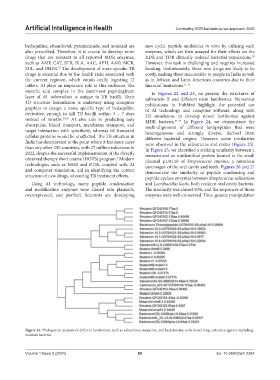
            mycolic acid complex in the outermost peptidoglycan   In  Figures  22  and  23, we present the structures of
            layer of  M. tuberculosis is unique to TB bacilli. Their   salivaricin B  and different nisin  lantibiotics. Numerous
            3D  structure  formulation  is underway using  computer   publications in PubMed highlight the potential use
            graphics to design a more specific type of bedaquiline   of AI technology and computer software, along with
            derivative, enough to kill TB bacilli within 3 – 7  days   3D simulation, to develop newer lantibiotics against
            instead of months. 28,29  AI also aids in predicting easy   MDR bacteria. 34-45  In  Figure  24, we demonstrate the
            absorption, blood transport, membrane transport, and   multi-alignment  of  different  lantipeptides  that  were
            target  interaction with  specificity, whereas 60  thousand   heterogeneous  and  strongly  diverse,  derived  from
            cellular proteins would be unaffected. The TB situation in   different  bacterial  origins.  However,  some  similarities
            India has deteriorated to the point where it has more cases   were observed in the salivaricins and nisins (Figure 23).
            than any other 250 countries, with 27 million infections in   In Figure 25, we identified a striking similarity between a
            2022, despite the successful implementation of the directly   mutacin and an unidentified protein located in the small
            observed therapy short course (DOTS) program.  Modern   plasmid pUA140 of  Streptococcus mutans, a notorious
                                                   7
            technologies such as NMR and FTIR, coupled with AI   carcinogen of the oral cavity and teeth. Figures 26 and 27
            and computer simulation, aid in identifying the correct   demonstrate the similarity of peptide condensing and
            structure of new drugs, advancing TB treatment efforts.  peptide cyclase enzymes between Streptococcus salivarious
              Using AI technology, many peptide condensation   and Lactobacillus lactis, both resident oral cavity bacteria.
            and modification enzymes were cloned into plasmids,   The similarity was almost 50%, and the sequences of those
            overexpressed, and purified. Scientists are developing   enzymes were well-conserved. Thus, genetic manipulation


            Figure 24. Phylogenetic analysis of different lantibiotics, such as salivaricins, mutacins, and bacteriocins, with broad range activities against multidrug-
            resistant bacteria


            Volume 1 Issue 2 (2024)                         89                               doi: 10.36922/aih.2284

