


Page 87 - AIH-1-2
P. 87
Artificial Intelligence in Health                               Combating XDR-bacteria as we approach 2050


            bacteria = 0.2 cfu/mL. Therefore, the chance of infection   infection, and the doctor prescribed the cefotaxime drug,
            by imipenem-resistant bacteria is approximately 579 times   which was proven effective. However, to avoid the risk of
            lower than that of ampicillin-resistant bacteria by bathing   MDR development, the author was subsequently prescribed
            or consuming Ganges River water. Thus, more people may   two higher derivatives of tetracycline and aminoglycoside
            be infected by ampicillin-resistant bacteria and still be   antibiotics. Fast forward to 2050, and a similar scenario
            cured with cefotaxime and imipenem drugs.          may unfold differently. For instance, if the author were to
              Certainly, in 2050, when the percentage of imipenem-  bathe in the Ganges River, the initial cefotaxime treatment
            resistant bacteria has increased, the situation will be   may not be effective, and if amikacin was also ineffective,
            different. It will be simpler to identify imipenem-resistant   then hospitalization would be recommended, usually
            bacteria by plating 0.1 mL Ganges river water onto a 10 cm   accompanied by  drug-sensitivity testing. In  such cases,
            LB + agar + imipenem plate. In 2050, doctors are likely   doripenem and meropenem therapy may be considered
            to perform drug sensitivity assays first using 100 antibiotic   next, but if the totally drug-resistant (TDR) infection or if
            paper disks to determine the nature of a patient’s blood,   all 100 available antibiotics in Kolkata medical stores have
            whether it is an MDR, extensively drug-resistant (XDR),   failed, then the doctor would seek help from the USA to
            or IDR infection. Obtaining such an assay result may cost a   obtain expensive and high-risk investigational drugs. This is
            few thousand rupees, and one may have to wait for 2 days   why scientists have predicted that there could be 10 million
            in order for the doctor to prescribe the correct antibiotic.   deaths in Asia annually by 2050. Simply put, people will not
            One of the authors (Asit Kumar Chakraborty) shares a   be able to afford the costly therapy, leading to their demise.
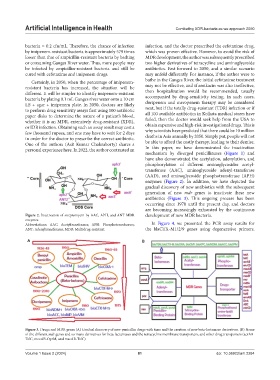
            personal experience here. In 2022, the author contrasted an   In this paper, we have demonstrated the inactivation
                                                               mechanism by diverged penicillinases (Figure  1) and
                                                               have also demonstrated the acetylation, adenylation, and
                                                               phosphorylation of different aminoglycosides acetyl-
                                                               transferase (AAC), aminoglycoside adenyl-transferase
                                                               (AAD), and aminoglycoside phosphotransferase (APH)
                                                               enzymes (Figure  2). In addition, we have depicted the
                                                               gradual discovery of new antibiotics with the subsequent
                                                               generation of new  mdr genes to inactivate these new
                                                               antibiotics (Figure  3). This ongoing process has been
                                                               occurring  since  1970  until  the  present  day, and  doctors
                                                               are becoming increasingly exhausted by the continuous
            Figure 2. Inactivation of streptomycin by AAC, APH, and ANT MDR   development of new MDR bacteria.
            enzymes
            Abbreviations: AAC: Acetyltransferases; APH: Phosphotransferases;   In  Figure  4, we presented the PCR assay results for
            ANT: Adenyltransferases; MDR: Multidrug-resistant.  the blaCTX-M1/2/9 genes using degenerative primers.

             A                                               B


            Figure 3. Drugs and MDR genes (A) Gradual discovery of new penicillin drugs with time and the creation of new beta-lactamase derivatives. (B) Name
            of the different mdr genes and so many derivatives for beta-lactamases and the tetracycline membrane transporters, and other drug transporters (acrAB-
            TolC, mexAB-OprM, and macAB-TolC)


            Volume 1 Issue 2 (2024)                         81                               doi: 10.36922/aih.2284

