


Page 126 - AIH-1-3
P. 126
Artificial Intelligence in Health                                 Interpretability of deep models for COVID-19


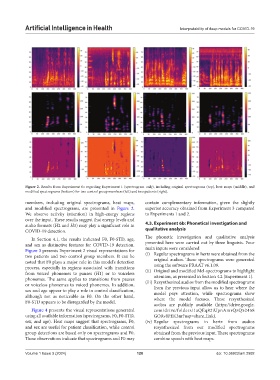
            Figure 2. Results from Experiment 6a regarding Experiment 1 (spectrogram only), including original spectrograms (top), heat maps (middle), and
            modified spectrograms (bottom) for two control group members (left) and two patients (right).

            members,  including  original  spectrograms,  heat  maps,   contain complementary information, given the slightly
            and modified spectrograms, are presented in  Figure  2.   superior accuracy obtained from Experiment 3 compared
            We observe activity (attention) in high-energy regions   to Experiments 1 and 2.
            over the input. These results suggest that energy levels and
            audio formats (H2 and H3) may play a significant role in   4.3. Experiment 6b: Phonetical investigation and
            COVID-19 detection.                                qualitative analysis
              In Section 4.1, the results indicated F0, F0-STD, age,   The phonetic investigation and qualitative analysis
            and sex as distinctive features for COVID-19 detection.   presented here  were  carried out  by three  linguists.  Four
            Figure 3 presents Experiment 2 visual representations for   main inputs were considered:
            two patients and two control group members. It can be   (i)  Regular spectrograms in hertz were obtained from the
            noted that F0 plays a major role in this model’s detection   original audios. These spectrograms were generated
            process, especially in  regions associated with transitions   using the software PRAAT v6.1.09.
            from voiced phonemes to pauses (H1) or to voiceless   (ii)  Original and modified Mel-spectrograms to highlight
            phonemes. The same applies to transitions from pauses   attention, as presented in Section 4.2 (Experiment 1).
            or voiceless phonemes to voiced phonemes. In addition,   (iii) Resynthesized audios from the modified spectrograms
                                                                  from the previous input allow us to hear where the
            sex and age appear to play a role in control classification,   model pays attention, while spectrograms show
            although not as noticeable as F0. On the other hand,   where the model focuses. These resynthesized
            F0-STD appears to be disregarded by the model.
                                                                  audios  are publicly  available  (https://drive.google.
              Figure 4 presents the visual representations generated   com/drive/folders/1aQEq82iUpnAmrQzQ52458
            using all available information (spectrograms, F0, F0-STD,   GORv8PEK3nr?usp=share_link).
            sex, and age). Heat maps suggest that spectrograms, F0,   (iv)  Regular spectrograms in hertz from audios
            and sex are useful for patient classification, while control   resynthesized from our modified spectrograms
            group detections are based only on spectrograms and F0.   obtained from the previous input. These spectrograms
            These observations indicate that spectrograms and F0 may   combine speech with heat maps.


            Volume 1 Issue 3 (2024)                        120                               doi: 10.36922/aih.2992

