


Page 128 - AIH-1-3
P. 128
Artificial Intelligence in Health                                 Interpretability of deep models for COVID-19


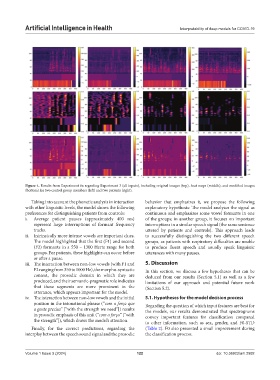
            Figure 4. Results from Experiment 6a regarding Experiment 3 (all inputs), including original images (top), heat maps (middle), and modified images
            (bottom) for two control group members (left) and two patients (right).

              Taking into account the phonetic analysis in interaction   behavior that emphasizes it, we propose the following
            with other linguistic levels, the model shows the following   explanatory hypothesis: The model analyzes the signal as
            preferences for distinguishing patients from controls:  continuous and emphasizes some vowel formants in one
            i.   Average patient pauses (approximately 400 ms)   of the groups; in another group, it focuses on important
               represent large interruptions of formant frequency   interruptions in a similar speech signal (the same sentence
               tracks.                                         uttered by patients and controls). This approach leads
            ii.  Intrinsically more intense vowels are important clues.   to  successfully  distinguishing the  two different speech
               The model highlighted that the first (F1) and second   groups, as patients with respiratory difficulties are unable
               (F2) formants in a 550 – 1300 Hertz range for both   to produce fluent speech and usually speak linguistic
               groups. For patients, these highlights can occur before   utterances with many pauses.
               or after a pause.
            iii.  The interaction between non-low vowels (with F1 and   5. Discussion
               F2 ranging from 350 to 1000 Hz), the morpho-syntactic   In this section, we discuss a few hypotheses that can be
               context, the  prosodic domain in which they are   deduced from our results (Section 5.1) as well as a few
               produced, and their semantic-pragmatic role indicates   limitations of our approach and potential future work
               that these segments  are more prominent in the   (Section 5.2).
               utterance, which appears important for the model.
            iv.  The interaction between non-low vowels and the initial   5.1. Hypotheses for the model decision process
               position in the intonational phrase (“com a força que   Regarding the question of which input features are best for
               a gente precisa” [“with the strength we need”]) results   the models, our results demonstrated that spectrograms
               in prosodic emphasis of this unit (“com a força” [“with   convey important features for classification compared
               the strength”]), which draws the model’s attention.  to other information, such as sex, gender, and F0-STD
              Finally, for the correct predictions, regarding the   (Table 2). F0 also presented a small improvement during
            interplay between the speech sound signal and the prosodic   the classification process.


            Volume 1 Issue 3 (2024)                        122                               doi: 10.36922/aih.2992

