


Page 72 - AIH-1-3
P. 72
Artificial Intelligence in Health                           Rotational thermography for breast cancer screening


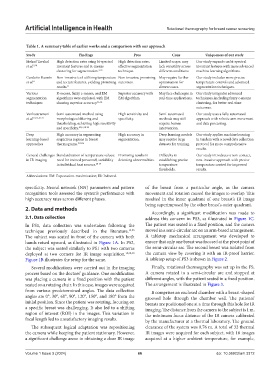
            Table 1. A summary table of earlier works and a comparison with our approach
            Study                  Findings               Pros            Cons          Uniqueness of our study
            Etehad Tavakol    High detection rates using bi-spectral   High detection rates;   Limited scope; may   Our study expands on bi-spectral
            et al. 7,10  invariant features and K-means   effective segmentation   lack versatility across   invariant features with more advanced
                         clustering for segmentation. 7,10  technique.  different conditions.  machine learning algorithms.
            Garduño-Ramón   Non-invasive tool utilizing temperature  Non-invasive; promising  May require further   Our study includes more precise
            et al. 11    and texture features, yielding promising  outcomes.  optimization for   temperature controls and advanced
                         results. 11                                 diverse cases.  segmentation techniques.
            Various      K-means, fuzzy c-means, and EM   Superior accuracy with   May face challenges in  Our study integrates advanced
            segmentation   algorithms were explored, with EM   EM algorithm.  real-time applications.  techniques, including fuzzy c-means
            techniques   showing superior accuracy. 11,12                            clustering, for better real-time
                                                                                     outcomes.
            Venkataramani    Semi-automated method using   High sensitivity and   Semi-automated   Our study uses a fully automated
            et al. 10,13,18-22  morphological filtering and   specificity.  methods may still   approach with robotic arm movement
                         thresholding, achieving high sensitivity    require human   and data processing.
                         and specificity. 10,13,18-22                intervention.
            Deep         High accuracy in segmenting   High accuracy in   Deep learning models  Our study applies machine learning
            learning-based   suspicious regions in breast   segmentation.  may require large   in tandem with a novel data collection
            approaches   thermograms. 9,23,24                        datasets for training.  protocol for more comprehensive
                                                                                     results.
            General challenges  Standardization of temperature values;  Promising results in   Difficulty in   Our study introduces a non-contact,
            in IR imaging  need for trained personnel; variability   detecting abnormalities.  establishing precise   non-invasive approach with precise
                         in individual heat sources. 28-34           temperature     temperature control for improved
                                                                     thresholds.     results.
            Abbreviations: EM: Expectation-maximization; IR: Infrared.

            specificity. Neural network (NN) parameters and pattern   of the breast from a particular angle, as the camera
            recognition tools assessed the system’s performance with   movement and rotation caused the images to overlap. This
            high accuracy rates across different phases.       resulted in the inner quadrant of one breast’s IR image
                                                               being superimposed by the other breast’s outer quadrant.
            2. Data and methods
                                                                 Accordingly, a significant modification was made to
            2.1. Data collection                               address this concern in PS3, as illustrated in  Figure  1C.
            In PS1, data collection was undertaken following the   The patient was seated in a fixed position, and the camera
            technique previously described in the literature. 14,35    moved in a semi-circular arc on an arm-based arrangement.
            The subject was seated in front of the camera with both   A  tabletop mechanical arrangement was developed to
            hands raised upward, as illustrated in Figure 1A. In PS2,   ensure that only one breast was focused at the pivot point of
            the subject was seated similarly to PS1 with two cameras   the semi-circular arc. The second breast was isolated from
            deployed at two corners for IR image acquisition. 14,30,36    the camera view by covering it with an IR-proof barrier.
            Figure 1B illustrates the setup for the same.      A tabletop setup of PS3 is shown in Figure 2.
              Several modifications were carried out in the imaging   Finally, rotational thermography was set up in the FS.
            process based on the doctors’ guidance. One modification   A  camera rotated in a semi-circular arc and stopped at
            was placing a camera in a fixed position with the patient   different angles, with the patient seated in a fixed position.
            seated on a rotating chair. In this case, images were acquired   The arrangement is illustrated in Figure 3.
            from  various predetermined  angles.  The data collection   It comprises an enclosed chamber with a breast-shaped
            angles are 0°, 30°, 60°, 90°, 120°, 150°, and 180° from the   grooved hole through the chamber wall. The patients’
            initial position. Since the patient was rotating, focusing on   breasts are positioned one at a time through this hole for IR
            a specific breast was challenging. It also led to a shifting   imaging. The distance from the camera to the subject is 1 m,
            region of interest (ROI) in the images. This variation in   the minimum focus distance of the IR camera calibrated
            focal length led to unsatisfactory imaging results.  by the manufacturer at a thermal laboratory. The ground
              The  subsequent  logical  adaptation  was  repositioning   clearance of the system was 0.76 m. A total of 32 thermal
            the camera while keeping the patient stationary. However,   IR images were acquired for each subject, with 16 images
            a significant challenge arose in obtaining a clear IR image   acquired at a higher ambient temperature, for example,


            Volume 1 Issue 3 (2024)                         66                               doi: 10.36922/aih.3312

