


Page 75 - AIH-1-3
P. 75
Artificial Intelligence in Health                           Rotational thermography for breast cancer screening


            2.3. IR-image feature-based analysis technique     Subsequently, another dataset was acquired in the lower

            In PS1 and PS2, the IR images were analyzed conventionally,   ambient temperature state. The differences between the two
            following  the  method  adopted  in  previous  studies.  The   datasets were the key discriminating features for analysis.
            features extracted were the mean, median, mode, standard   This novel analysis technique was tested on 88 subjects
            deviation, histogram, and maximum value. Analysis   from a hospital in northeast India. Figure 6 displays the
            was conducted in consultation with doctors, but no   frontal view of the IR images of a subject’s affected and
            reference was made to IR images acquired through USG,   normal breasts, highlighted by the red and blue zones,
            mammography, or biopsy.                            respectively.
              In PS3, the primary reference source was the USG   2.3.1. Temperature area clustering method
            and biopsy reports obtained through other modalities. IR   The number of pixels corresponding to each temperature
            image-based clustering was used for image segmentation   cluster zone was recorded during IR image analysis. The
            and to extract the ROI.                            total number of pixels represented the area of each zone.

              The  mean temperature  of  each  ROI,  interpreted   For example, the camera used in this study captures a 640
            as different body temperature zones, was used as the   × 480–pixel IR image, which is considered to be 100%
            discriminating feature. IR image K-means clustering   area. Accordingly, if a particular zone had 7962 pixels, it
            was  used  for  clustering  the  other  image  features. 12,25,28    spread over 2.59% of the IR image and was known as a
            The clustering method was gradually improved, and the   percent area cluster. The distributions of these area zones
            number of clusters was optimized from 20 to seven based   across different temperatures are depicted in  Figure  7
            on experimental validation by consulting doctors based on   using bar plots. Higher temperature regions indicative of
            abnormalities found in the USG and biopsy reports. This   abnormalities are conventionally represented in specific
            study extracted temperature-based clustering features for   colors. The color scale in the  figure does not mark the
            IR image segmentation for 33 subjects.  In the next stage of   seven cluster zones described in this paper. Instead, it
                                          8
            development (FS), the image background and foreground   only demonstrates the color temperature relative to the IR
            were separated through FCM clustering.  Figure 5 shows   image, while the clusters are outlined plots overlayed on
                                             7
            the variation in the IR breast images captured from different   the IR image.
            angles, with the abnormality detected by the software and   Figure 7 illustrates the real-world implications of the
            doctors as irregular and box-shaped ROI, respectively.  temperature zone versus percent area cluster analysis.
              Final IR image analysis was accomplished after   For the patient in question, imaging at a higher ambient
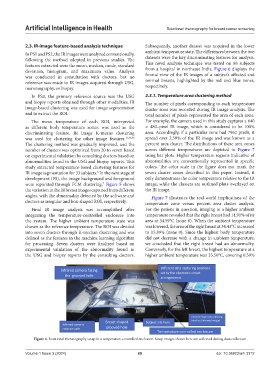
            integrating the temperature-controlled enclosure into   temperature revealed that the right breast had 14.91% of its
            the system. The higher ambient temperature state was   area at 34.59°C (zone 0). When the ambient temperature
            chosen as the reference temperature. The ROI was divided   was lowered, the area of the right breast at 34.43°C increased
            into seven clusters through K-median clustering and was   to 15.89% (zone 0). Since the highest body temperature
            defined as the features in the machine learning algorithm   did not decrease with a change in ambient temperature,
            for processing. Seven clusters were finalized based on   we concluded that the right breast had an abnormality.
            experimental validation of the abnormality found in   Conversely, for the left breast, the highest temperature at a
            the USG and biopsy reports by the consulting doctors.   higher ambient temperature was 33.50°C, covering 0.59%


               Figure 4. Rotational thermography setup in a temperature-controlled enclosure. Setup images shown here are collected during data collection


            Volume 1 Issue 3 (2024)                         69                               doi: 10.36922/aih.3312

