


Page 78 - AIH-1-3
P. 78
Artificial Intelligence in Health                           Rotational thermography for breast cancer screening


            different angles of the breast, dynamic IR image collection   across various breast cancer scenarios. Table 3 displays the
            in a temperature-controlled enclosed chamber, and a   patient data table with all the patients’ demographics and
            simplified user interface for data collection, analysis, and   the disease stage.
            interpretation.                                      In terms of control, the study employed a comprehensive
              Regarding data analysis techniques, PS1 and PS2   diagnostic approach, including comparisons between
            followed conventional methods used in previous studies.   symptomatic and asymptomatic patients, various imaging
            Features such as mean, median, mode, standard deviation,   techniques, and cross-referencing with other diagnostic
            histogram,  and maximum  value were extracted  from   methods. This control approach thoroughly assessed the
            the IR images. However, no reference was made to   system’s performance and reliability in different clinical
            images acquired through other modalities, such as USG,   contexts.
            mammography, or biopsy. The PS3 and FS are complete   Healthy patients were recruited as controls, providing
            with the information about PS1 and PS2, assessed for their   a benchmark  for assessing the system’s accuracy and
            value in the research article.                     specificity. Their demographics included a diverse range
              In PS3, a shift toward a more comprehensive analysis   of ages and breast health statuses, reflecting the general
            technique was observed. The primary reference source   population and allowing for a comprehensive evaluation of
            became the USG, and biopsy reports were obtained   the system’s performance across different patient profiles.
            through other modalities. IR image-based clustering was   The correlation between temperature and readouts is
            employed to segment and extract the ROI. The mean   critical for evaluating the breast cancer screening system
            temperature of each ROI was used as a discriminating   using IR thermography. Analyses of mean temperature and
            feature, and K-means clustering was applied to cluster   standard deviation showed the system’s ability to identify
            other image features. The clustering method was gradually   potential  abnormalities  based  on  temperature  variations
            improved, and the number of clusters was optimized based   in breast tissue. Improved clustering techniques in later
            on experimental validation and consultation with doctors.  phases enhanced the precision of detecting abnormalities.
              The FS phase enhanced the data analysis technique by   Overall, the positive correlation between temperature and
            separating the image background and foreground through   readouts highlights the system’s potential as an effective
            FCM clustering. This allowed for better detection and   diagnostic tool for breast cancer screening.
            delineation of abnormalities in the IR breast images. The   3.2. Result B
            collaboration between software analysis tools and medical
            experts resulted in identifying irregularly shaped and   A meticulous qualitative statistical analysis evaluated
            box-shaped ROIs as potential abnormalities, as shown in   abnormality detection accuracy in the captured IR
            Figure 5.                                          images.  Table 4 comprehensively summarizes the
                                                               detected abnormalities and their corresponding accuracy
              The study demonstrated the importance of integrating
            data collection and analysis techniques to improve the   percentages for each study phase. Notably, a progressive
                                                               enhancement in accuracy was observed throughout the
            performance of breast cancer screening systems using IR   study duration, with PS3 and the final stage (FS) achieving
            thermography. The iterative improvements in the data
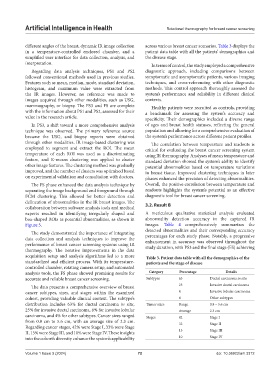
            acquisition setup and  analysis  algorithms led to  a  more   Table 3. Patient data table with all the demographics of the
            standardized and efficient process. With its temperature-  patients and the stage of disease
            controlled chamber, rotating camera setup, and automated
            analysis tools, the FS phase showed promising results for   Category  Percentage     Details
            accurate and reliable breast cancer screening.     Subtypes      63           Ductal carcinoma in situ
              The data presents a comprehensive overview of breast           25           Invasive ductal carcinoma
            cancer subtypes, sizes, and stages within the examined           8            Invasive lobular carcinoma
            cohort, providing valuable clinical context. The subtype’s       4            Other subtypes
            distribution includes 63% for ductal carcinoma  in situ,   Tumor sizes  Range  0.8 – 5.6 cm
            25% for invasive ductal carcinoma, 8% for invasive lobular       Average      2.3 cm
            carcinoma, and 4% for other subtypes. Cancer sizes ranged   Stages  42        Stage I
            from 0.8  cm to 5.6  cm, with an average size of 2.3  cm.        33           Stage II
            Regarding cancer stages, 42% were Stage I, 33% were Stage
            II, 15% were Stage III, and 10% were Stage IV. These insights    15           Stage III
            into the cohort’s diversity enhance the system’s applicability   10           Stage IV


            Volume 1 Issue 3 (2024)                         72                               doi: 10.36922/aih.3312

