


Page 80 - AIH-1-3
P. 80
Artificial Intelligence in Health                           Rotational thermography for breast cancer screening


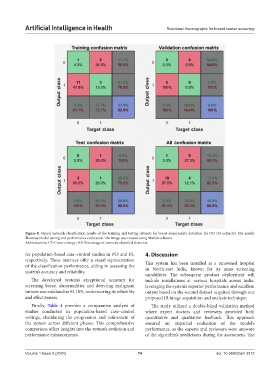
            Figure 8. Neural network classification results of the training and testing datasets for breast abnormality detection for PS3 (33 subjects). The results
            illustrate model tuning and performance evaluation. The image was created using Matlab software.
            Abbreviations: CE: Cross-entropy; %E: Percentage of correctly classified elements.

            for population-based case–control studies in PS3 and FS,   4. Discussion
            respectively. These matrices offer a visual representation
            of the classification performance, aiding in assessing the   This system has been installed at a renowned hospital
            system’s accuracy and reliability.                 in North-east India, known for its mass screening
                                                               capabilities. The subsequent product deployment will
              The developed system’s exceptional accuracy for   include  installations at  various  hospitals  across India,
            screening breast abnormalities and detecting malignant   leveraging the system’s superior performance and excellent
            tumors was validated at 93.18%, underscoring its reliability   output based on the second dataset acquired through our
            and effectiveness.                                 proposed IR image acquisition and analysis technique.
              Finally,  Table 4 provides a comparative analysis of   The study utilized a double-blind validation method
            studies  conducted in  population-based  case–control   where expert doctors and reviewers provided both
            settings, elucidating the progression and refinement of   quantitative and qualitative feedback. This approach
            the system across different phases. This comprehensive   ensured an impartial evaluation of the model’s
            comparison offers insights into the system’s evolution and   performance, as the experts and reviewers were unaware
            performance enhancements.                          of the algorithm’s predictions during the assessment. The


            Volume 1 Issue 3 (2024)                         74                               doi: 10.36922/aih.3312

