


Page 81 - AIH-1-3
P. 81
Artificial Intelligence in Health                           Rotational thermography for breast cancer screening


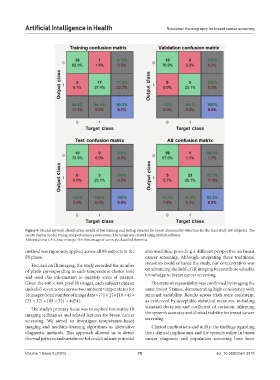
            Figure 9. Neural network classification results of the training and testing datasets for breast abnormality detection for the final study (88 subjects). The
            results display model tuning and performance evaluation. The image was created using Matlab software.
            Abbreviations: CE: Cross-entropy; %E: Percentage of correctly classified elements.

            method was rigorously applied across all 88 subjects in the   abnormalities, providing a different perspective on breast
            FS phase.                                          cancer  screening.  Although  integrating  these  traditional
              Focused on IR imaging, the study recorded the number   measures could enhance the study, our concentration was
            of pixels corresponding to each temperature cluster zone   on advancing the field of IR imaging to contribute valuable
            and used this information to quantify areas of interest.   knowledge to breast cancer screening.
            Given the 640 × 480-pixel IR images, each subject’s dataset   The system’s repeatability was confirmed by imaging the
            included seven zones across two ambient temperatures for   same breast 5 times, demonstrating high consistency with
            16 images (total number of image data = [71 × 2] + [10 × 4] +   minimal variability. Results across trials were consistent,
            [33 × 32] + [88 × 32] = 4054).                     as evidenced by acceptable statistical measures, including
              The study’s primary focus was to explore innovative IR   standard deviation and coefficient of variation, affirming
            imaging techniques and related features for breast cancer   the system’s accuracy and clinical viability for breast cancer
            screening. We aimed to investigate temperature-based   screening.
            imaging  and  machine-learning  algorithms  as  alternative   Clinical implications and utility: the findings regarding
            diagnostic methods. This approach allowed us to detect   their clinical implications and the system’s utility in breast
            thermal patterns and variations that could indicate potential   cancer diagnosis and population screening have been


            Volume 1 Issue 3 (2024)                         75                               doi: 10.36922/aih.3312

