


Page 116 - AIH-1-4
P. 116
Artificial Intelligence in Health                        Complex early diagnosis of MS through machine learning


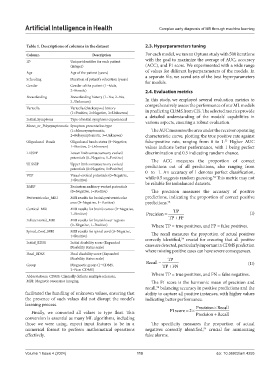
            Table 1. Descriptions of columns in the dataset    2.3. Hyperparameters tuning
            Column                      Description            For each model, we ran an Optuna study with 500 iterations
            ID                 Unique identifier for each patient   with the goal to maximize the average of AUC, accuracy
                               (integer)                       (ACC), and F1 score. We experimented with a wide range
            Age                Age of the patient (years)      of values for different hyperparameters of the models. In
            Schooling          Duration of patient’s education (years)  a separate file, we saved sets of the best hyperparameters
                                                               for models.
            Gender             Gender of the patient (1=Male,
                               2=Female)                       2.4. Evaluation metrics
            Breastfeeding      Breastfeeding history (1=Yes, 2=No,   In this study, we employed several evaluation metrics to
                               3=Unknown)
            Varicella          Varicella (chickenpox) history   comprehensively assess the performance of our ML models
                               (1=Positive, 2=Negative, 3=Unknown)  in predicting CDMS from CIS. The selected metrics provide
            Initial_Symptoms   Type of initial symptoms experienced  a detailed understanding of the models’ capabilities in
                                                               various aspects, ensuring a robust evaluation.
            Mono_or_Polysymptomatic Symptom presentation type
                               (1=Monosymptomatic,               The AUC measures the area under the receiver operating
                               2=Polysymptomatic, 3=Unknown)   characteristic curve, plotting the true positive rate against
                                                                                                 53
            Oligoclonal_Bands  Oligoclonal bands status (0=Negative,   false-positive rate, ranging from 0 to 1.  Higher AUC
                               1=Positive, 2=Unknown)          values indicate better performance, with 1 being perfect
            LLSSEP             Lower limb somatosensory evoked   discrimination and 0.5 indicating random chance.
                               potentials (0=Negative, 1=Positive)  The ACC measures the proportion of correct
            ULSSEP             Upper limb somatosensory evoked   predictions out of all predictions, also ranging from
                               potentials (0=Negative, 1=Positive)
            VEP                Visual-evoked potentials (0=Negative,   0  to  1. An accuracy of 1 denotes perfect classification,
                                                               while 0.5 suggests random guessing.  This metric may not
                                                                                            54
                               1=Positive)
            BAEP               Brainstem auditory-evoked potentials   be reliable for imbalanced datasets.
                               (0=Negative, 1=Positive)          The precision measures the accuracy of positive
            Periventricular_MRI  MRI results for brain’s periventricular   predictions, indicating the proportion of correct positive
                               area (0=Negative, 1=Positive)   predictions. 54
            Cortical_MRI       MRI results for brain’s cortex (0=Negative,   TP
                               1=Positive)                     Precision                                  (I)
            Infratentorial_MRI  MRI results for brain’s lower regions    TP FP
                               (0=Negative, 1=Positive)          Where TP = true positives, and FP = false positives.
            Spinal_Cord_MRI    MRI results for spinal cord (0=Negative,   The recall measures the proportion of actual positives
                               1=Positive)                                    54
            Initial_EDSS       Initial disability score (Expanded   correctly identified,  crucial for ensuring that all positive
                                                               cases are detected, particularly important in CDMS prediction
                               Disability Status scale)
            Final_EDSS         Final disability score (Expanded   where missing positive cases can have severe consequences.
                               Disability Status scale)                 TP
            Group              Diagnostic group (1=CDMS,       Recall   TP FN                             (II)

                               2=Non-CDMS)
            Abbreviations: CDMS: Clinically definite multiple sclerosis;   Where TP = true positives, and FN = false negatives.
            MRI: Magnetic resonance imaging.                     The F1 score is the harmonic mean of precision and
                                                               recall,  balancing accuracy in positive predictions and the
                                                                    54
            facilitated the handling of unknown values, ensuring that   ability to capture all positive instances, with higher values
            the presence of such values did not disrupt the model’s   indicating better performance.
            learning process.                                                       PrecisionRecall
                                                                                  2
              Finally, we converted all values to type float. This       Fscore1    PrecisionRecall

            conversion is essential as many ML algorithms, including
            those we were using, expect input features to be in a   The specificity measures the proportion of actual
            numerical format to perform mathematical operations   negatives correctly identified,  crucial for minimizing
                                                                                        54
            effectively.                                       false alarms.


            Volume 1 Issue 4 (2024)                        110                               doi: 10.36922/aih.4255

