


Page 119 - AIH-1-4
P. 119
Artificial Intelligence in Health                        Complex early diagnosis of MS through machine learning


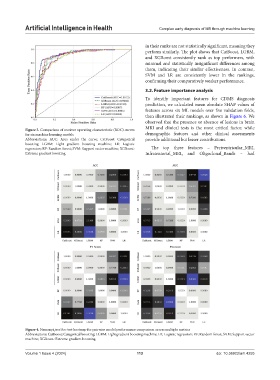
                                                               in their ranks are not statistically significant, meaning they
                                                               perform similarly. The plot shows that CatBoost, LGBM,
                                                               and XGBoost consistently rank as top performers, with
                                                               minimal and statistically insignificant differences among
                                                               them, indicating their similar effectiveness. In contrast,
                                                               SVM and LR are consistently lower in the rankings,
                                                               confirming their comparatively weaker performance.
                                                               3.2. Feature importance analysis
                                                               To identify important features for CDMS diagnosis
                                                               prediction, we calculated mean absolute SHAP values of
                                                               features across six ML models over five validation folds,
                                                               then illustrated their rankings, as shown in Figure 6. We
                                                               observed that the presence or absence of lesions in brain
            Figure 3. Comparison of receiver operating characteristic (ROC) curves   MRI  and  clinical  tests  is  the  most  critical  factor,  while
            for six machine learning models                    demographic  features  and  other  clinical  assessments
            Abbreviations: AUC: Area under the curve; CatBoost: Categorical   provide additional but lesser contributions.
            boosting; LGBM: Light gradient boosting machine; LR: Logistic
            regression; RF: Random forest; SVM: Support vector machine; XGBoost:   The top three features – Periventricular_MRI,
            Extreme gradient boosting.                         Infratentorial_MRI, and Oligoclonal_Bands – had


            Figure 4. Nemenyi post hoc test heatmap for pairwise model performance comparison across multiple metrics
            Abbreviations: CatBoost: Categorical boosting; LGBM: Light gradient boosting machine; LR: Logistic regression; RF: Random forest; SVM: Support vector
            machine; XGBoost: Extreme gradient boosting.


            Volume 1 Issue 4 (2024)                        113                               doi: 10.36922/aih.4255

