


Page 118 - AIH-1-4
P. 118
Artificial Intelligence in Health                        Complex early diagnosis of MS through machine learning


              CatBoost emerged as the top performer with an AUC of   alarms is critical. Overall, CatBoost, XGBoost, and LGBM
            0.9312, a balanced F1 score of 0.8675, precision of 0.8710,   are the most reliable models for CDMS prediction, with
            recall  of  0.8640,  and  specificity  of  0.8919,  showcasing   CatBoost excelling in sensitivity, reducing false negatives,
            its effectiveness in both positive and negative case   and ensuring accurate diagnoses.
            identification. LGBM matched CatBoost closely in these
            metrics, making it another strong classifier. XGBoost also   3.1.2. Statistical significance of model performance
            performed well with an AUC of 0.9202 but showed slightly   Figure 4 shows the Nemenyi post hoc test heatmap. It shows
            less balanced precision and recall compared to CatBoost   that CatBoost, LGBM, and XGBoost consistently ranked
            and LGBM. RF, while having a solid AUC of 0.9097,   as the best models. However, the differences between these
            exhibited less balance in precision and recall, resulting in   models were not statistically significant, as shown by higher
            more false positives.                              P-values in most metrics. However, we observe significant

              SVM and LR demonstrated lower performance overall.   differences between these top models and the lower-
            SVM’s AUC of 0.8985 and F1 score of 0.8031 indicated   performing models, particularly LR and SVM. For instance,
            moderate effectiveness but higher false-positive rates. LR   P-values from the Nemenyi test showed that CatBoost did
            had the lowest performance, with an AUC of 0.8922 and   much better than LR in AUC, supporting earlier findings
            the lowest balance between precision and recall, making it   that gradient-boosted models are better at predicting
            the least effective model evaluated.               CDMS. This statistical validation underscores the reliability
                                                               of the gradient-boosted models, particularly CatBoost and
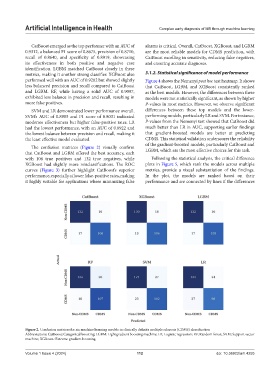
              The confusion matrices (Figure  2) visually confirm
            that CatBoost and LGBM offered the best accuracy, each   LGBM, which are the most effective choices for this task.
            with 108 true positives and 132 true negatives, while   Following the statistical analysis, the critical difference
            XGBoost  had slightly more misclassifications.  The  ROC   plots in Figure 5, which rank the models across multiple
            curves (Figure  3) further highlight CatBoost’s superior   metrics, provide a visual substantiation of the findings.
            performance, especially at lower false-positive rates, making   In the plot, the models are ranked based on their
            it highly suitable for applications where minimizing false   performance and are connected by lines if the differences


            Figure 2. Confusion matrices for six machine learning models in clinically definite multiple sclerosis (CDMS) classification
            Abbreviations: CatBoost: Categorical boosting; LGBM: Light gradient boosting machine; LR: Logistic regression; RF: Random forest; SVM: Support vector
            machine; XGBoost: Extreme gradient boosting.


            Volume 1 Issue 4 (2024)                        112                               doi: 10.36922/aih.4255

