


Page 75 - AIH-1-4
P. 75
Artificial Intelligence in Health                                     ML models for heartbeat classification


            4. Discussion                                      Table 3. Comparison between the proposed ML model
                                                               and state‑of‑art algorithms in terms of their accuracy
            XGBoost, the best-performing classifier, was applied   performance
            to the test set to generate a confusion matrix, assessing
            the effectiveness of the classification model. An overall   Approach           Overall accuracy (%)
            accuracy of 99.96% demonstrated the model’s ability to   Proposed approach                   99.96
            classify ECG signals more accurately than other MLmodels.   ML models with Optimized RF 46                   97.7
            Table 3 highlights the superior performance of our method   Deep LSTM 47                   95.80
            in efficiently and automatically identifying arrhythmias   Deep 1D-CNN 48                   97.00
            through  the  classification  of  heartbeats  from  the  ECG   17
            signals. The accuracy of the proposed method with balanced   CNN+LSTM                      99.35
            data surpasses that of other state-of-art methods, especially   RC+NG-RC 44      96.05 and 98.28
            for the N, S, and V categories (Table 1), achieving values   Bi-LSTMs 49                   98.70
            of 99.96% and 95.68% for training and test, respectively.
            These values represent greater performance than obtained
            with other state-of-the-art methods that use the previously
            proposed reservoir computing (RC) and next-generation
            RC approaches.  While a previous study  achieved an
                                              45
                         44
            accuracy of 99.6% by introducing a CNN-based model
            with feature component analysis for multimodal ECG
            tasks on the MIT-BIH dataset, our model exhibits sound
            performance by incorporating the FT and Gaussian noise
            injection techniques. Another study  explored heartbeat
                                         17
            classification and arrhythmia detection using multimodel
            deep learning techniques such as a one-dimensional CNN
            and long short-term memory network, achieving overall
            accuracies of 99.59% and 99.35%, respectively, which are
            lower than those achieved in our study, supporting the
            reliability of our model in heartbeat classification. The
            proposed approach also requires lesser training time and is
            more cost-effective than other state-of-the-art algorithms,
            which are often deemed expensive and time-consuming.
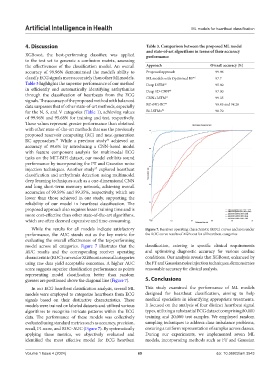
              While the results for all models indicate satisfactory   Figure 7. Receiver operating characteristic (ROC) curves and area under
            performance, the AUC stands  out as the key  metric for   the ROC curve results of XGBoost for all heartbeat categories
            evaluating the overall effectiveness of the top-performing
            model across all categories.  Figure  7  illustrates that the   classification, catering to specific clinical requirements
            AUC results and the corresponding receiver operating   and optimizing diagnostic accuracy for various cardiac
            characteristic (ROC) curves for XGBoost across all categories   conditions. Our analysis reveals that XGBoost, enhanced by
            using raw data yield acceptable outcomes. A higher AUC   the FT and Gaussian noise injection techniques, demonstrates
            score suggests superior classification performance as points   reasonable accuracy for clinical analysis.
            representing model classification better than random
            guesses are positioned above the diagonal line (Figure 7).  5. Conclusions
              In our ECG heartbeat classification analysis, several ML   This study examined the performance of ML models
            models were employed to categorize heartbeats from ECG   designed for heartbeat classification, aiming to help
            signals based on their distinctive characteristics. These   medical specialists in identifying appropriate treatments.
            models were trained on labeled datasets and utilized various   It focused on the analysis of four distinct heartbeat signal
            algorithms to recognize intricate patterns within the ECG   types, utilizing a substantial ECG dataset comprising 80,000
            data.  The  performance  of  these  models  was  collectively   training and 20,000 test samples. We  employed random
            evaluated using standard metrics such as accuracy, precision,   sampling techniques to address class imbalance problems,
            recall, F1 score, and ROC‒AUC (Figure 7). By systematically   ensuring a uniform representation of samples across classes.
            applying these metrics, we objectively evaluated and   During our experiments, we implemented seven ML
            identified the most effective model for ECG heartbeat   models, incorporating methods such as FT and Gaussian

            Volume 1 Issue 4 (2024)                         69                               doi: 10.36922/aih.3543

