


Page 74 - AIH-1-4
P. 74
Artificial Intelligence in Health                                     ML models for heartbeat classification


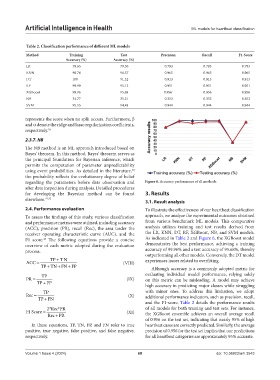
            Table 2. Classification performance of different ML models
            Method             Training             Test             Precision         Recall          F1‑Score
                             Accuracy (%)        Accuracy (%)
            LR                  79.65               79.30              0.793            0.793           0.793
            KNN                 98.74               96.57              0.965            0.965           0.965
            DT                       100            91.32              0.913            0.913           0.913
            RF                  99.99               95.12              0.951            0.951           0.951
            XGBoost             99.96               95.68              0.956`           0.956           0.956
            NB                  34.77               35.21              0.352            0.352           0.352
            SVM                 95.55               94.48              0.944            0.944           0.944


            represents the score when no split occurs. Furthermore, β
            and α denote the ridge and lasso regularization coefficients,
            respectively. 39
            2.3.7. NB
            The NB method is an ML approach introduced based on
            Bayes’ theorem. In this method, Bayes’ theorem serves as
            the principal foundation for Bayesian inference, which
            permits the computation of parameter unpredictability
            using event probabilities. As detailed in the literature,
                                                         40
            the probability reflects the evolutionary degree of belief
            regarding the  parameters  before data  observation and   Figure 6. Accuracy performance of all methods
            after data inspection during analysis. Detailed procedures
            for developing the Bayesian method can be found    3. Results
            elsewhere. 41,42                                   3.1. Result analysis

            2.4. Performance evaluation                        To illustrate the effectiveness of our heartbeat classification
            To assess the findings of this study, various classification   approach, we analyze the experimental outcomes obtained
            and performance metrics were utilized, including accuracy   from various benchmark ML models. This comparative
            (ACC), precision (PR), recall (Rec), the area under the   analysis utilizes training and test results derived from
            receiver operating characteristic curve (AUC), and the   the LR, KNN, DT, RF, XGBoost, NB, and SVM models.
            F1 score.  The following equations provide a concise   As indicated in Table 2 and Figure 6, the XGBoost model
                    43
            overview of each metric adopted during the evaluation   demonstrates the best performance, achieving a training
            process.                                           accuracy of 99.96% and a test accuracy of 95.68%, thereby
                                                               outperforming all other models. Conversely, the DT model
                      TP T N+                                  experiences issues related to overfitting.
            ACC =                                    (VIII)
                  TP TN FN FP+  +  +                             Although accuracy is a commonly adopted metric for
                   TP                                          evaluating individual model performance, relying solely
            PR =                                       (IX)    on  this  metric  can  be  misleading.  A  model  may  achieve
                 TP FP+
                                                               high accuracy in predicting major classes while struggling
                   TP                                          with minor ones. To address this limitation, we adopt
            Rec =                                       (X)    additional performance indicators, such as precision, recall,
                    +
                 TP FN
                                                               and the F1-score.  Table 2 details the performance results
                     2*Rec*PR                                  of all models for both training and test sets. For instance,
            F1 Score =                                 (XI)    the XGBoost ensemble achieves an overall average recall
                     Rec PR+
                                                               of 0.956 on the test set, indicating that nearly 95% of high
              In these equations, TP, TN, FP, and FN refer to true   heartbeat cases are correctly predicted. Similarly, the average
            positive, true negative, false positive, and false negative,   precision of 0.956 for the test set implies that our predictions
            respectively.                                      for all heartbeat categories are approximately 95% accurate.


            Volume 1 Issue 4 (2024)                         68                               doi: 10.36922/aih.3543

