


Page 69 - AIH-1-4
P. 69
Artificial Intelligence in Health                                     ML models for heartbeat classification


            •   Evaluate the scaling of the ML models with varying   The adopted dataset consists of ECG recordings from
               dataset sizes, emphasizing the manner in which   205 heartbeat signals. To protect the personal information
               preprocessing methods and algorithm adaptations help   of the patients, appropriate measures are undertaken to
               maintain efficiency and effectiveness across different   ensure fairness in the evaluation process, which utilizes
               data volumes.                                   a training set comprising 80,000  samples for model

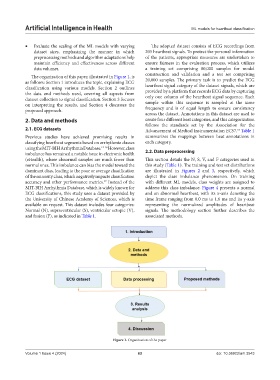
              The organization of this paper, illustrated in Figure 1, is   construction and validation and a test set comprising
            as follows: Section 1 introduces the topic, explaining ECG   20,000 samples. The primary task is to predict the ECG
            classification using various models. Section 2 outlines   heartbeat signal category of the dataset signals, which are
            the data and methods used, covering all aspects from   provided by a platform that records ECG data by capturing
            dataset collection to signal classification. Section 3 focuses   only one column of the heartbeat signal sequence. Each
            on interpreting the results, and Section 4 discusses the   sample within this sequence is sampled at the same
            proposed approach.                                 frequency and is of equal length to ensure consistency
                                                               across the dataset. Annotations in this dataset are used to
            2. Data and methods                                create four different beat categories, and this categorization
                                                               follows the standards set by the Association for the
            2.1. ECG datasets                                  Advancement of Medical Instrumentation EC57.  Table 1
                                                                                                      18
            Previous studies have achieved promising results in   summarizes the mappings between beat annotations in
            classifying heartbeat segments based on arrhythmia classes   each category.
            using the MIT-BIH Arrhythmia Database. 14-16  However, class
            imbalance has remained a notable issue in electronic health   2.2. Data preprocessing
            (eHealth), where abnormal samples are much fewer than   This section details the N, S, V, and F categories used in
            normal ones. This imbalance can bias the model toward the   this study (Table 1). The training and test set distributions
            dominant class, leading to the poor or average classification   are illustrated in  Figures  2  and  3, respectively, which
            of the minority class, which negatively impacts classification   depict the class imbalance phenomenon. On training
            accuracy and other performance metrics.  Instead of the   with different ML models, class weights are assigned to
                                             17
            MIT-BIH Arrhythmia Database, which is widely known for   address this class imbalance. Figure 4 presents a normal
            ECG classifications, this study uses a dataset provided by   and an abnormal heartbeat, with its x-axis denoting the
            the University of Chinese Academy of Sciences, which is   time frame ranging from 0.0 ms to 1.6 ms and its y-axis
            available on request. This dataset includes four categories:   representing the normalized amplitudes of heartbeat
            Normal (N), supraventricular (S), ventricular ectopic (V),   signals. The methodology section further describes the
            and fusion (F), as indicated in Table 1.           associated methods.


                                                 Figure 1. Organization of the paper

            Volume 1 Issue 4 (2024)                         63                               doi: 10.36922/aih.3543

