


Page 64 - AIH-1-4
P. 64
Artificial Intelligence in Health                                   A fuzzy system for heartbeat classification


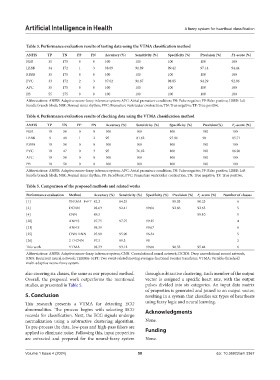
            Table 3. Performance evaluation results of testing data using the VTMA classification method
            ANFIS    TP     TN    FP    FN    Accuracy (%)  Sensitivity (%)  Specificity (%)  Precision (%)  F1-score (%)
            NSR       35    175    0     0    100          100          100           100          100
            LBBB      34    172    1     3    98.09        91.89        99.42         97.14        94.44
            RBBB      35    175    0     0    100          100          100           100          100
            PVC       33    172    2     3    97.62        91.67        98.85         94.29        92.96
            APC       35    175    0     0    100          100          100           100          100
            PB        55    275    0     0    100          100          100           100          100
            Abbreviations: ANFIS: Adaptive neuro-fuzzy inference system; APC: Atrial premature condition; FN: False negative; FP: False positive; LBBB: Left
            bundle branch block; NSR: Normal sinus rhythm; PVC: Premature ventricular contraction; TN: True negative; TP: True positive.

            Table 4. Performance evaluation results of checking data using the VTMA classification method
            ANFIS    TP    TN     FP    FN    Accuracy (%)  Sensitivity (%)  Specificity (%)  Precision(%)  F -score (%)
                                                                                                     1
            NSR       10    50     0     0    100          100           100           100          100
            LBBB      9     48     1     2    95           81.82         97.96         90           85.71
            RBBB      10    50     0     0    100          100           100           100          100
            PVC       10    47     0     3    95           76.92         100           100          86.96
            APC       10    50     0     0    100          100           100           100          100
            PB        10    50     0     0    100          100           100           100          100
            Abbreviations: ANFIS: Adaptive neuro-fuzzy inference system; APC: Atrial premature condition; FN: False negative; FP: False positive; LBBB: Left
            bundle branch block; NSR: Normal sinus rhythm; PB: Paced beat; PVC: Premature ventricular contraction; TN: True negative; TP: True positive.

            Table 5. Comparison of the proposed methods and related works
            Performance evaluation  Method  Accuracy (%)  Sensitivity (%)  Specificity (%)  Precision (%)  F -score (%)  Number of classes
                                                                                      1
            [1]               TERMA- FrFT 82.2      84.25      -          89.03      80.23            6
            [2]               DCNN       98.63      92.41      99.06      92.86      92.63            5
            [4]               CNN        89.3       -          -          -          89.10            1
            [20]              ANFIS      97.75      97.75      99.25      -          -                4
            [21]              ANFIS      98.39      -          99.67      -          -                6
            [25]              CNN-RNN    95.90      95.90      96.34      -          -                5
            [26]              2-D CNN    97.3       89.3       98         -          -                2
            This work         VTMA       98.33      93.12      99.66      98.33      95.44            6
            Abbreviations: ANFIS: Adaptive neuro-fuzzy inference system; CNN: Convolutional neural network; DCNN: Deep convolutional neural network;
            RNN: Recurrent neural network; TERMA- FrFT: Two event-related moving averages-fractional Fourier transform; VTMA: Variable-threshold
            multi-adaptive neuro-fuzzy system.

            also covering six classes, the same as our proposed method.   through subtractive clustering. Each member of the output
            Overall, the proposed work outperforms the mentioned   vector  is  assigned  a  specific  heart  rate,  with  the  output
            studies, as presented in Table 5.                  pulses  divided  into  six  categories.  An  input  data  matrix
                                                               of properties is generated and joined to an output vector,
            5. Conclusion                                      resulting in a system that classifies six types of heartbeats
            This research presents a VTMA for detecting ECG    using fuzzy logic and neural learning.
            abnormalities. The process begins with selecting ECG   Acknowledgments
            records for classification. Next, the ECG signals undergo
            normalization using a subtractive clustering algorithm.   None.
            To pre-process the data, low-pass and high-pass filters are
            applied to eliminate noise. Following this, input properties   Funding
            are extracted and prepared for the neural-fuzzy system   None.


            Volume 1 Issue 4 (2024)                         58                               doi: 10.36922/aih.3367

