


Page 62 - AIH-1-4
P. 62
Artificial Intelligence in Health                                   A fuzzy system for heartbeat classification


                         A                                   B


                         C                                     D


                         E
                                                               F


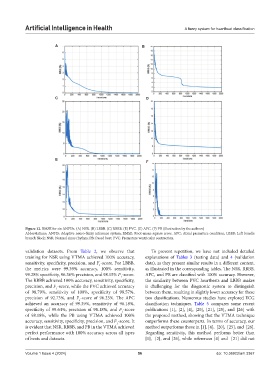
            Figure 12. RMSE for six ANFISs. (A) NSR. (B) LBBB. (C) RBBB. (E) PVC. (E) APC. (F) PB (illustration by the authors)
            Abbreviations: ANFIS: Adaptive neuro-fuzzy inference system; RMSE: Root-mean-square error; APC: Atrial premature condition; LBBB: Left bundle
            branch block; NSR: Normal sinus rhythm; PB: Paced beat; PVC: Premature ventricular contraction.


            validation datasets. From  Table  2, we observe that   To prevent repetition, we have not included detailed
            training for NSR using VTMA achieved 100% accuracy,   explanations of  Tables  3 (testing data) and  4  (validation
            sensitivity, specificity, precision, and F -score. For LBBB,   data), as they present similar results in a different context,
                                           1
            the metrics were 99.39% accuracy, 100% sensitivity,   as illustrated in the corresponding tables. The NSR, RBBB,
            99.28% specificity, 96.36% precision, and 98.15% F -score.   APC, and PB are classified with 100% accuracy. However,
                                                    1
            The RBBB achieved 100% accuracy, sensitivity, specificity,   the similarity between PVC heartbeats and LBBB makes
            precision, and F -score, while the PVC achieved accuracy   it challenging for the diagnostic system to distinguish
                         1
            of 98.79%, sensitivity of 100%, specificity of 98.57%,   between them, resulting in slightly lower accuracy for these
            precision of 92.73%, and  F -score of 96.23%. The APC   two classifications. Numerous studies have explored ECG
                                   1
            achieved  an  accuracy  of  99.39%,  sensitivity  of  98.18%,   classification techniques.  Table  5 compares some recent
            specificity of 99.64%, precision of 98.18%, and  F -score   publications [1], [2], [4], [20], [21], [25], and [26] with
                                                     1
            of 98.18%, while the PB using VTMA achieved 100%   the proposed method, showing that the VTMA technique
            accuracy, sensitivity, specificity, precision, and F -score. It   outperforms these counterparts. In terms of accuracy, our
                                                   1
            is evident that NSR, RBBB, and PB in the VTMA achieved   method outperforms those in [1], [4],  [20],  [25], and  [26].
            perfect performance with 100% accuracy across all types   Regarding sensitivity, this method performs better than
            of beats and datasets.                             [1],  [2], and [26], while references [4] and  [21] did not


            Volume 1 Issue 4 (2024)                         56                               doi: 10.36922/aih.3367

