


Page 61 - AIH-1-4
P. 61
Artificial Intelligence in Health                                   A fuzzy system for heartbeat classification


                                                               defined as abnormal beats. In Figure 13, the sub-figures are
                                                               depicted with different  markings to show the performance
                                                               clearly. Blue circular shows the actual data, however, they
                                                               are covered by classified data. Red cross points represent
                                                               the classified data (accurate or  inaccurate) before applying
                                                               the variable thresholds. At the same time, black star points
                                                               demonstrate checking  classification after implementing
                                                               the variable threshold. From  Figure  13, it is concluded
                                                               that the application of the threshold in the NSR and RBBB
                                                               systems is insignificant because they are accurate enough
                                                               due to their distinguished characteristics. The LBBB and
                                                               PVC beats are similar in  terms of some characteristics, so
                                                               it is demanding for the ANFIS to distinguish these beats
                                                               100% accurately  thus, the accuracy of classification is
                                                               somewhat lower than other beats; this fact is more obvious
                                                               in PVC  beat classification, and it can be seen in simulation
            Figure 10. Step size curve of NSR for the proposed VTMA (illustration   results.  The APC classification is  done   efficiently,  and
            by the authors)                                    applying variable threshold plays a prominent role in
            Abbreviations: NSR: Normal sinus rhythm; VTMA: Variable-threshold   the classification of these kinds of  beats. In PB beats, the
            multi-adaptive neuro-fuzzy system.                 effective role of applying threshold is illustrated, and there
                                                               is no irregularity in classification.  As a result, PVC, APC,
                                                               LBBB, and  PB classification have  improved dramatically
                                                               and these  changes convey the meaning of the strong impact
                                                               of putting a variable threshold on the six ANFIS outputs.
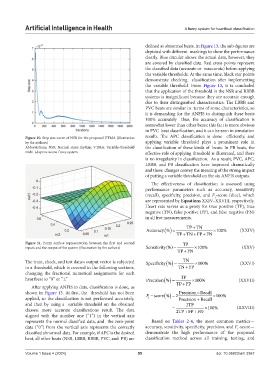
                                                                 The effectiveness of classification is assessed using
                                                               performance parameters such as accuracy, sensitivity
                                                               (recall), specificity, precision, and  F -score (dice),  which
                                                                                            1
                                                               are represented by Equations XXIV–XXVIII, respectively.
                                                               Heart rate serves as a proxy for true positive (TP), true
                                                               negative (TN), false positive (FP), and false negative (FN)
                                                               in all five measurements.

                                                                                TP TN+
                                                               Accuracy % () =              ×100 %     (XXIV)
                                                                            TP TN FP FN+  +  +
            Figure  11. Fuzzy surface representation between the first and second   TP
            inputs and the output of the system (illustration by the authors)  Sensitivity%() =  ×100 %  (XXV)
                                                                             TP FN+

            The train, check, and test data›s output vector is subjected   Specificity% () =  TN  ×100 %  (XXVI)
            to a threshold, which is covered in the following sections,      TN FP+
            changing the fractional numerical assignments for each
            heartbeat to “0” or “1.”                           Precision% () =  TP  ×100 %             (XXVII)
              After applying ANFIS to data, classification is done, as      TP FP+
                                                                                     ×
            shown in Figure 13. At first, the  threshold has not been        PrecisionRecall
                                                                       () =
            applied, so the classification is not performed accurately,   F −score%  2  PrecisionRecall × 100%
                                                                                     +
                                                                1
            and then by using a  variable threshold on the obtained             2TP
            classes, more accurate classifications result. The data       =  2TP FFP FN+  ×100 %      (XXVIII)
                                                                                +
            aligned with the number one (“1”) in the vertical axis
            represents the normal classified data, and  the zero-point   Based on  Tables  2-4, the most common metrics—
            data (“0”) from the vertical axis represents the correctly   accuracy, sensitivity, specificity, precision, and F -score—
                                                                                                      1
            classified abnormal  data. For example, if APC is the desired   demonstrate the high performance of the proposed
            beat, all other beats (NSR, LBBB, RBBB, PVC, and  PB) are   classification method across all training, testing, and
            Volume 1 Issue 4 (2024)                         55                               doi: 10.36922/aih.3367

