


Page 58 - AIH-1-4
P. 58
Artificial Intelligence in Health                                   A fuzzy system for heartbeat classification


            selecting which records to use in the algorithm is based   are plotted to verify whether the features of  Table  1 are
            on the number of specific  beats in that record.  Table  1   extracted correctly from the annotation function or not.
            shows the input properties by input numbers that are   Here, histograms of the other five types of heartbeats are
            important for discussing the FIS membership functions.   avoided, and only diagrams subject to the normal heart
            For diminutive clusters, for each input, a cluster (Gaussian   rate of one of the records are given in Figure 8. Histograms
            membership functions) is created and the diminutive   are helpful to see the data distribution and to show the
            clustering algorithm normalizes the input properties.   differences in the outputs. Histograms of Figure 8E-K are
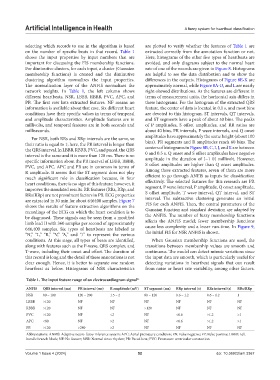
            The normalization layer of the ANFIS normalizes the   approximately normal, while Figure 8A-D, and L are nearly
            network weights. In  Table  1, the left column shows   right-skewed distributions. As the features are different in
            different heartbeats, NSR, LBBB, RBBB, PVC, APC, and   terms of measurement units, the horizontal axis differs in
            PB. The first row lists extracted features. NF means no   these histograms. For the histogram of the extracted QRS
            information is available about that case. Six different heart   feature, the center of data is located in 0.1 s, and most bins
            conditions have their specific values in terms of temporal   are devoted to this histogram. ST intervals, QT intervals,
            and amplitude  characteristics.  Amplitude  features  are  in   and ST segments have a peak of about 50 bins. The peaks
            millivolts, and temporal features are in both seconds and   of P amplitudes, S offset amplitudes, and RR ratios are
            milliseconds.                                      about 40 bins. PR intervals, P wave intervals, and Q onset
              For NSR, both RRs and RRp intervals are the same, so   amplitudes have approximately the same height (about 100
            their ratio is equal to 1; here, the PR interval is longer than   bins). PR segments and R amplitudes reach 60 bins. The
            the QRS interval. In LBBB, RBBB, PVC, and paced, the QRS   centers of histograms in Figure 8B, C, I, J, and K are between
            interval is the same and it is more than 120 ms. There is no   0 and 0.5 s. Q onset and S offset amplitudes have negative
            specific information about the PR interval of LBBB, RBBB,   amplitude in the duration of [−1  0] millivolt. However,
            PVC, and APC. APC and PB are in common in terms of   S  offset  amplitudes  are higher  than Q  onset  amplitudes.
            R amplitude. It seems that the ST segment does not play   Among these extracted features, seven of them are more
            much significant role in classification because, in four   efficient to go through ANFIS as inputs for classification
            heart conditions, there is no sign of this feature; however, it   effectively. The selected features for this research are PR
            improves the simulated results. RR features (RRs, RRp, and   segment, P wave interval, P amplitude, Q onset amplitude,
            RRs/RRp) are not prominent factors in PB. ECG properties   S offset amplitude, T wave interval, QT interval, and ST
            are extracted in 30 min for about 646400 samples. Figure 7   interval. The subtractive clustering generates an initial
            shows the results of feature extraction algorithms on the   FIS for each ANFIS. Then, the central parameters of the
            recordings of the ECG on which the heart condition is to   Gaussian function and standard deviation are adapted by
            be diagnosed. These signals can be seen from a modified   the ANFIS. The number of fuzzy membership functions
            limb lead II with 360 samples per second of approximately   affects the ANFIS model; fewer membership functions
            646,400  samples. Six types of heartbeats are labeled as   cause less complexity and a lesser run-time. In Figure 9,
            “N,” “L,” “R,” “V,” “A,” and “/” to represent the various   the initial FIS for NSR ANFIS is shown.
            conditions. At this stage, all types of beats are identified,   When Gaussian membership functions are used, the
            along with features such as the P-wave, QRS complex, and   transitions between  membership  values  are  smooth and
            T-wave, including their onset and offset. The duration of   continuous. The model can detect minute variations since
            this record is long and the detail of these annotations is not   the input data are smooth, which is particularly useful for
            clear enough. Hence, it is better to separate one random   detecting variations in heartbeat signals that can result
            heartbeat as below. Histograms of NSR characteristics   from noise or heart rate variability, among other factors.


            Table 1. The input feature range of an electrocardiogram signal 21
            ANFIS  QRS interval (ms)  PR interval (ms)  R amplitude (mV)  ST segment (ms)  RRp interval (s)  RRs interval (s)  RRs/RRp
            NSR    80 – 100       120 – 200     1.5 – 2       80 – 120      0.6 – 1.2    0.6 – 1.2    1
            LBBB   >120           NF            NF            NF            NF           NF           NF
            RBBB   >120           NF            NF            >120          NF           NF           NF
            PVC    >120           NF            <2            NF            <0.6         >1.2         >1
            APC    <80            NF            >2            NF            <0.6         >1.2         >1
            PB     >120           >280          >2            NF            NF           NF           NF
            Abbreviations: ANFIS: Adaptive neuro-fuzzy inference system; APC: Atrial premature condition; FN: False negative; FP: False positive; LBBB: Left
            bundle branch block; NF: No feature; NSR: Normal sinus rhythm; PB: Paced beat; PVC: Premature ventricular contraction.


            Volume 1 Issue 4 (2024)                         52                               doi: 10.36922/aih.3367

