


Page 55 - AIH-1-4
P. 55
Artificial Intelligence in Health A fuzzy system for heartbeat classification
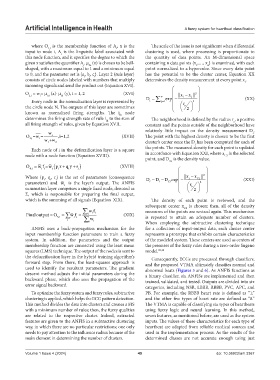
where O is the membership function of A, x is the The scale of the issue is not significant when differential
1,i
i
input to node i, A is the linguistic label associated with clustering is used, where processing is proportionate to
i
this node function, and it specifies the degree to which the the quantity of data points. An M-dimensional space
given x satisfies the quantifier A. µ (x) is chosen to be bell- containing n data points {x ,…, x } is examined, with each
Ai
i
1
n
shaped, with a maximum equal to 1 and a minimum equal point normalized to a hypercube. Since every data point
to 0, and the parameter set is {a, b, c}. Layer 2 (rule layer) has the potential to be the cluster center, Equation XX
i
i
i
consists of circle nodes labeled with numbers that multiply determines the density measurement at every point x .
i
incoming signals and send the product out (Equation XVI).
O = w = µ (x)∙ µ (y), i = 1, 2 (XVI) n ||x − x || 2
i
Bi
2,I
Ai
i
j
Every node in the normalization layer is represented by D = =1 exp − r 2 (XX)
i ∑ j
the circle node N. The outputs of this layer are sometimes a 2
known as normalized firing strengths. The i node
th
determines the firing strength rate of rule i to the sum of The neighborhood is defined by the radius r , a positive
th
a
all firing strength of rules, given by Equation XVII. constant and the points outside of the neighborhood have
w relatively little impact on the density measurement D .
i
i
O=w = w+w 2 ,i=1,2 (XVII) The point with the highest density is chosen to be the first
3,i
i
cluster’s center once the D has been computed for each of
1
i
Each node of i in the defuzzification layer is a square the points. The measured density for each point is updated
node with a node function (Equation XVIII). in accordance with Equation XXI, where x is the selected
C1
point, and D is the density value.
C1
O = w fw px qy r= ( i + i + i ) (XVIII)
i
i
4,
i i
2
Where {p, q , r } is the set of parameters (consequence D = D − Dexp − ||x − x || (XXI)
C1
i
i
i
i
parameters) and w is the layer’s output. The ANFIS i i C1 r 2
i
summation layer comprises a single fixed node, denoted as b 2
Σ, which is responsible for preparing the final output,
which is the summing of all signals (Equation XIX). The density of each point is reviewed, and the
subsequent center x is chosen; then, all of the density
C2
i ∑ wf measures of the points are revised again. This mechanism
FinaloutputO= 51, = ∑ wf = ii (XIX) is repeated to attain an adequate number of clusters.
ii
i i ∑ w i When employing the subtractive clustering technique
ANFIS uses a back-propagation mechanism for the for a collection of input-output data, each cluster center
input membership function parameters to train a fuzzy represents a prototype that exhibits certain characteristics
system. In addition, the parameters and the output of the modeled system. These centers are used as centers of
membership function are connected using the least mean the premises of the fuzzy rules during a zero-order Sugeno
squares (LMS) technique. The output of the nodes is sent to model. 29,30
the defuzzification layer in the hybrid training algorithm’s Consequently, ECGs are processed through classifiers,
forward step. From there, the least-squares approach is and the proposed VTMA ultimately classifies normal and
used to identify the resultant parameters. The gradient abnormal beats (Figures 5 and 6). As ANFIS functions as
descent method adjusts the initial parameters during the a binary classifier, six ANFISs are implemented and then
backward phase, which also sees the propagation of the trained, validated, and tested. Outputs are divided into six
error signal backward. categories, including NSR, LBBB, RBBB, PVC, APC, and
To optimize the fuzzy system and fuzzy rules, subtractive PB. For example, the RBBB heart rate is defined as “1,”
clustering is applied, which helps the ECG pattern detection. and the other five types of heart rate are defined as “0.”
This method divides the data into clusters and creates a FIS The VTMA is capable of classifying six types of heartbeats
with a minimum number of rules; then, the fuzzy qualities using fuzzy logic and neural learning. In this method,
are related to the respective cluster. Indeed, extracted seven features, as mentioned before, are used as the system
features are given to the ANFIS in a subtractive clustering inputs. The values of these characteristics for each type of
way, in which there are no particular restrictions; one only heartbeat are adapted from reliable medical sources and
needs to pay attention to the influence radius because of the used in the implementation process. As the results of the
main element in determining the number of clusters. determined classes are not accurate enough using just
Volume 1 Issue 4 (2024) 49 doi: 10.36922/aih.3367

