


Page 50 - AIH-1-4
P. 50
Artificial Intelligence in Health                                   A fuzzy system for heartbeat classification


            by medical professionals for more than 70 years to identify   medical professionals are responsible for this task. This
            heart conditions, such as arrhythmias.  The heart’s rhythm   extra workload compounds the fatigue that medical staff
                                          1
            and bioelectrical activity are expressed in an ECG. Adults   already experience, raising the risk of medical errors.
            typically have a resting heart rate between 60 and 100   Furthermore,  a  large  percentage  of  the  received  ECG
            beats/min. A  lower resting heart rate typically indicates   recordings are often false alarms, as remote monitoring
            improved cardiovascular fitness and more effective cardiac   devices are highly sensitive to ECG abnormalities and may
            function. An athlete who has received proper training, for   not effectively filter out significant cardiovascular events.
            instance, may typically have a resting heart rate of about   As a result, helping doctors interpret ECGs has become
            40 beats/min. In contrast, heart disease can alter the shape   increasingly important.
            and  characteristics  of  the  heartbeats  seen  in an  ECG,   Every year, millions of ECG recordings are taken
            resulting in significant deviations from the normal pattern.  globally, with most being automatically processed and

              Cardiac arrhythmias are common in CVDs, and their   deciphered by computers. This places pressure on the
            accurate classification is crucial, as successful treatment   ECG interpretation techniques to be patient- and device-
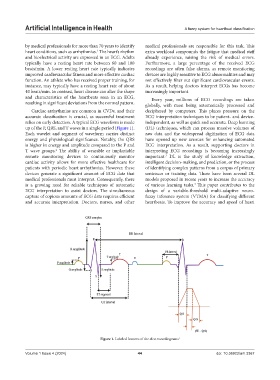
            relies on early detection. A typical ECG waveform is made   independent, as well as quick and accurate. Deep learning
            up of the P, QRS, and T waves in a single period (Figure 1).   (DL) techniques, which can process massive volumes of
            Each wavelet and segment of waveform carries distinct   raw data and the widespread digitization of ECG data
            energy and physiological significance. Notably, the QRS   have opened up new avenues for enhancing automated
            is higher in energy and amplitude compared to the P and   ECG interpretation. As a result, supporting doctors in
                         2
            T wave groups.  The ability of wearable or implantable   interpreting ECG recordings is becoming increasingly
            remote monitoring devices to continuously monitor   important.  DL is the study of knowledge extraction,
                                                                       3
            cardiac activity allows for more effective healthcare for   intelligent decision-making, and prediction, or the process
            patients with periodic heart arrhythmias. However, these   of identifying complex patterns from a corpus of primary
            devices generate a significant amount of ECG data that   sentences or training data. There have been several DL
            medical professionals must interpret. Consequently, there   models proposed in recent years to increase the accuracy
            is a growing need for reliable techniques of automatic   of various learning tasks.  This paper contributes to the
                                                                                    4
            ECG  interpretation to  assist doctors. The  simultaneous   design of a variable-threshold multi-adaptive neuro-
            capture of copious amounts of ECG data requires efficient   fuzzy inference system (VTMA) for classifying different
            and accurate interpretation. Doctors, nurses, and other   heartbeats. To improve the accuracy and speed of heart


                                            Figure 1. Labeled features of the electrocardiograms 1


            Volume 1 Issue 4 (2024)                         44                               doi: 10.36922/aih.3367

