


Page 65 - AIH-2-1
P. 65
Artificial Intelligence in Health                                Algorithm and metal oxide nanoparticle in MRI


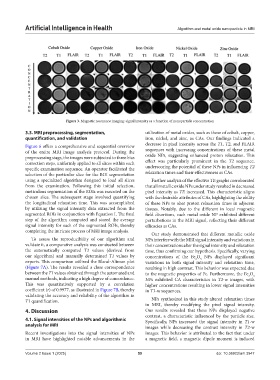
                             Figure 3. Magnetic resonance imaging: signal intensity as a function of nanoparticle concentration
            3.3. MRI preprocessing, segmentation,              utilization of metal oxides, such as those of cobalt, copper,
            quantification, and validation                     iron, nickel, and zinc, as CAs. Our findings indicated a
            Figure 6 offers a comprehensive and sequential overview   decrease in pixel intensity across the T1, T2, and FLAIR
            of the entire MRI image analysis protocol. During the   sequences with increasing concentrations of these metal
            preprocessing stage, the images were subjected to three bias   oxide NPs, suggesting enhanced proton relaxation. This
            correction steps, uniformly applied to all slices within each   effect was particularly prominent in the  T2 sequence,
            specific examination sequence. An operator facilitated the   underscoring the potential of these NPs in influencing T2
            selection of the particular slice for the ROI segmentation   relaxation times and their effectiveness as CAs.
            using a specialized algorithm designed to load all slices   Further analysis of the effective TE graphs corroborated
            from the examination. Following this  initial  selection,   that all metallic oxide NPs under study resulted in decreased
            meticulous segmentation of the ROIs was executed on the   pixel intensity as TE increased. This characteristic aligns
            chosen slice. The subsequent stage involved quantifying   with the desirable attributes of CAs, highlighting the ability
            the longitudinal relaxation time. This was accomplished   of these NPs to alter proton relaxation times in adjacent
            by utilizing the signal intensity data extracted from the   tissues. Notably, due to the different in local magnetic
            segmented ROIs in conjunction with Equation I. The final   field disortions, each metal oxide NP exhibited different
            step of the algorithm computed and stored the average   perturbations in the MRI signal, reflecting their different
            signal intensity for each of the segmented ROIs, thereby   efficacies as CAs.
            completing the intricate process of MRI image analysis.
                                                                 Our study demonstrated that different metallic oxide
              To  assess  the  reproducibility  of  our  algorithm  and   NPs interfere with the MRI signal intensity and variations in
            validate it, a comparative analysis was conducted between   their concentrations alter the signal intensity and relaxation
            the automatically computed  T1 values (derived from   time, thus confirming our hypothesis. Specifically, varying
            our algorithm) and manually determined  T1 values by   concentrations of the Fe O  NPs displayed significant
                                                                                    2
                                                                                      3
            experts. This comparison utilized the Bland‒Altman plot   variations in both signal intensity and relaxation time,
            (Figure 7A). The results revealed a close correspondence   resulting in high contrast. This behavior was expected due
            between the T1 values obtained through the automated and   to the magnetic properties of Fe. Furthermore, the Fe O
                                                                                                             3
                                                                                                           2
            manual methods, indicating a high degree of concordance.   NPs exhibited CA characteristics in  T2-w images, with
            This was quantitatively supported by a correlation   higher concentrations resulting in lower signal intensities
            coefficient (r) of 0.9977, as illustrated in Figure 7B, thereby   in T1-w sequences.
            validating the accuracy and reliability of the algorithm in
            T1 quantification.                                   NPs synthesized in this study altered relaxation times
                                                               in MRI, thereby modifying the pixel signal intensity.
            4. Discussion                                      Our results revealed that these NPs displayed negative
                                                               contrast, a characteristic influenced by the particle size.
            4.1. Signal intensities of the NPs and algorithmic   Specifically,  NPs  increased  the  signal  intensity  in  T1-w
            analysis for MRI                                   images while decreasing the contrast intensity in  T2-w
            Recent investigations into the signal intensities of NPs   images. This behavior is attributed to the fact that under
            in MRI have highlighted notable advancements in the   a  magnetic  field,  a  magnetic  dipole  moment  is  induced


            Volume 2 Issue 1 (2025)                         59                               doi: 10.36922/aih.3947

