


Page 99 - AIH-2-2
P. 99
Artificial Intelligence in Health                                         Cirrhosis prediction in hepatitis C


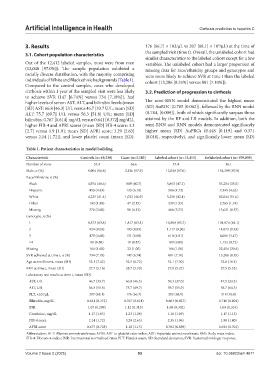
            3. Results                                         176 [66.7] × 103/µL vs 207 [68.1] × 10 /µL) at the time of
                                                                                              3
                                                               the sampled visit (time t). Overall, the unlabeled cohort had
            3.1. Cohort population characteristics
                                                               similar characteristics to the labeled cohort except for a few
            Out of the 12,412 labeled samples, most were from men   variables. The unlabeled cohort had a larger proportion of
            (12,040 [97.0%]). The sample population exhibited a   missing data for race/ethnicity groups and genotypes and
            racially diverse distribution, with the majority comprising   were more likely to achieve SVR at time t than the labeled
            individuals of White and Black ethnic backgrounds (Table 1).   cohort (13,286 [8.35%] versus 881 [7.10%]).
            Compared to the control samples, cases who developed
            cirrhosis within 1 year of the sampled visit were less likely   3.2. Prediction of progression to cirrhosis
            to achieve SVR (147 [6.74%] versus 734 [7.18%]), had
            higher levels of serum AST, ALT, and bilirubin levels (mean   The semi-RNN model demonstrated the highest mean
            [SD] AST: 66.8 [46.3] U/L versus 46.7 [33.7 U/L; mean [SD]   (SD) AuROC (0.785 [0.062]), followed by the RNN model
            ALT: 75.7 [69.7] U/L versus 56.3 [51.8] U/L; mean [SD]   (0.744, [0.009]), both of which significantly surpass those
            bilirubin: 0.767 [0.614] mg/dL versus 0.641 [0.372] mg/dL),   attained by the RF and LR models. In addition, both the
            higher FIB-4 and APRI scores (mean [SD] FIB-4 score: 3.3   semi-RNN and RNN models demonstrated significantly
            [2.7] versus 1.9 [1.9]; mean [SD] APRI score: 3.29 [2.63]   higher  mean  (SD)  AuPRCs  (0.448  [0.119]  and  0.371
            versus 2.14 [1.72]), and lower platelet count (mean [SD]:   [0.010], respectively), and significantly lower mean (SD)

            Table 1. Patient characteristics in model building
            Characteristic         Controls (n=10,230)  Cases (n=2,182)  Labeled cohort (n=12,412)  Unlabeled cohort (n=159,039)
            Number of visits             55.4            66.6             57.4                   36.1
            Male, n (%)               9,904 (96.8)    2,136 (97.9)      12,040 (97.0)         154,299 (97.0)
            Race/Ethnicity, n (%)
             Black                    4,974 (48.6)     889 (40.7)       5,863 (47.2)          53,254 (33.5)
             Hispanic                  453 (4.43)      133 (6.10)        586 (4.72)            7,345 (4.62)
             White                    4,235 (41.4)    1,023 (46.9)      5,258 (42.4)          82,044 (51.6)
             Other                     192 (1.88)      47 (2.15)         239 (1.93)            2,765 (1.74)
             Missing                   376 (3.68)      90 (4.12)         466 (3.75)           13,631 (8.57)
            Genotype, n (%)
             1                        8,573 (83.8)    1,817 (83.3)      10,390 (83.7)         101,874 (64.1)
             2                         924 (9.03)      193 (8.85)       1,117 (9.00)          14,873 (9.33)
             3                         479 (4.68)      131 (6.00)        610 (4.91)            8,686 (5.47)
             ≥4                        90 (0.88)       19 (0.87)         109 (0.88)            1,152 (0.72)
            Missing                    164 (1.60)      22 (1.00)         186 (1.50)           32,454 (20.4)
            SVR achieved at time t, n (%)  734 (7.18)  147 (6.74)        881 (7.10)           13,286 (8.35)
            Age at enrollment, mean (SD)  52.1 (7.42)  52.5 (6.72)      52.1 (7.30)            52.8 (19.1)
            BMI at time t, mean (SD)   27.7 (5.16)     28.7 (5.70)      27.8 (5.27)            27.5 (5.55)
            Laboratory test results at time t, mean (SD)
             AST, U/L                  46.7 (33.7)     66.8 (46.3)      50.3 (37.0)            47.5 (33.3)
             ALT, U/L                  56.3 (51.8)     75.7 (69.7)      59.7 (55.9)            56.7 (64.3)
             PLT, ×10 /µL              207 (68.1)      176 (66.7)        202 (68.9)            218 (76.8)
                   3
             Bilirubin, mg/dL         0.641 (0.372)   0.767 (0.614)     0.663 (0.427)         0.716 (0.604)
             INR                      1.07 (0.299)    1.12 (0.313)      1.08 (0.302)           1.09 (0.333)
             Creatinine, mg/dL         1.17 (1.05)     1.23 (1.28)      1.18 (1.09)            1.17 (1.13)
             FIB-4 score               2.14 (1.72)     3.29 (2.63)      2.35 (1.96)            1.98 (1.40)
             APRI score               0.677 (0.728)    1.16 (1.15)      0.762 (0.839)         0.644 (0.701)
            Abbreviation: ALT: Alanine aminotransferase; APRI: AST-to-platelet ratio index; AST: Aspartate aminotransferase; BMI: Body mass index;
            FIB-4: Fibrosis-4 index; INR: International normalized ratio; PLT: Platelet count; SD: Standard deviation; SVR: Sustained virologic response.


            Volume 2 Issue 2 (2025)                         93                               doi: 10.36922/aih.4671

