


Page 119 - AIH-2-3
P. 119
Artificial Intelligence in Health                              Opportunities for AI-based arrhythmia screening


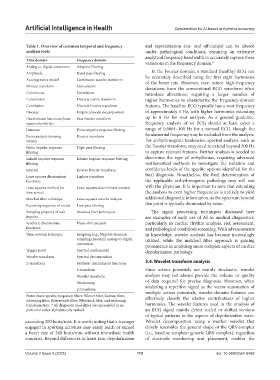
            Table 1. Overview of common temporal and frequency   and repolarization (on-  and off-ramps) can be altered
            analysis tools                                     under pathological conditions, requiring an extensive
                                                               analytical frequency bandwidth to accurately capture these
            Time domain           Frequency domain
                                                               variations in the frequency domain. 8
            Analog-to-digital conversion  Adaptive filtering
            Amplitude             Band-pass filtering            In the Fourier domain, a standard (healthy) ECG can
            Autoregressive model  Continuous wavelet transform  be  accurately  described  using  the  first  eight  harmonics
                                                               of the heart rate. However, even minor high-frequency
            Bilinear transform    Convolution                  deviations from the conventional ECG waveform often
            Continuous            Correlation                  introduce  alterations, requiring a  larger  number  of
            Convolution           Discrete cosine transform    higher harmonics to characterize the frequency-domain
            Correlation           Discrete Fourier transform   features. The baseline ECG typically has a root frequency
            Discrete              Empirical mode decomposition   of approximately 1 Hz, with higher harmonics extending
            Discriminant functions (least   Fast Fourier transform  up to 8  Hz for root analysis. As a general guideline,
            squares/synthetic)                                 frequency analysis of an ECG should at least cover a
            Duration              Finite impulse response filtering  range of 0.0001–100  Hz for a normal ECG, though the
            Event analysis (missing   Fourier transform        fundamental frequency may be excluded from the analysis.
            events)                                            For arrhythmogenic tendencies, spectral analysis, such as
            Finite impulse response   High-pass filtering      the Fourier transform, may need to extend beyond 200 Hz
            filtering                                          to capture relevant features. Further analysis is needed to
            Infinite impulse response   Infinite impulse response filtering  determine the type of arrhythmias, requiring advanced
            filtering                                          mathematical methods to investigate the isolation and
            Interval              Inverse Fourier transform    confidence levels of the specific options identified for the
            Least squares discriminant   Laplace transform     final diagnosis. Nonetheless, the final determination of
            functions                                          the  applicable  arrhythmogenic  pathology may  still  rest
            Least squares method (in   Least-squares discriminant analysis  with the physician. It is important to note that extending
            time series)                                       the analysis to even higher frequencies is unlikely to yield
            Matched filter technique  Least-squares wavelet analysis  additional diagnostic information, as the spectrum beyond
            Recurring sequence of events  Low-pass filtering   this point is typically dominated by noise.
            Sampling property of unit   Matched filter techniques  The signal processing techniques discussed here
            impulse                                            are examples of early use of AI in medical diagnostics,
            Synthetic discriminant   Phase-shift analysis      particularly in cardiac rhythm analysis, risk assessment,
            functions                                          and pathological conditions screening. With advancements
            Time-reversal technique  Sampling (e.g., Nyquist–Shannon   in knowledge, wavelet analysis has become increasingly
                                  sampling theorem), analog-to-digital   utilized, while the matched filter approach is gaining
                                  conversion                   prominence in analyzing more complex aspects of cardiac
            Trigger point         Spectral confinement         depolarization pathology.
            Wavelet transform     Spectral decomposition
            Z-transform           Synthetic discriminant functions  3.4. Wavelet transform analysis
                                  S-transform                  Since action potentials are mainly stochastic, wavelet
                                  Wavelet transform            analysis may not always provide the volume or quality
                                  Windowing                    of data required for precise diagnosis. However, when
                                  Z-transform                  analyzing a repetitive signal as the vector summation of
            Notes: Some specific frequency filters: Wiener filter, Kalman filter,   multiple action potentials, wavelet-domain features can
                                                               effectively classify the relative contributions of higher
            whitening filter, Butterworth filter, Whiterock filter, and whitening
            transformation;   All diagnostic modalities are represented in no   harmonics. The wavelet features used in the analysis of
                       11
            particular order, alphabetically ranked.           an ECG signal mainly detect scaled or shifted versions
                                                               of typical patterns or the aspects of depolarization wave.
            exceeding 200 beats/min. It is worth noting that a teenager   Wavelet decomposition using a mother wavelet that
            engaged in sporting activities may easily reach or exceed   closely resembles the general shape of the QRS complex
            a  heart  rate of 240  beats/min  without immediate  health   (i.e., baseline template: generic QRS complex), regardless
            concerns. Beyond differences in heart rate, depolarization   of electrode numbering and placement, enables the


            Volume 2 Issue 3 (2025)                        113                               doi: 10.36922/aih.8468

