


Page 121 - AIH-2-3
P. 121
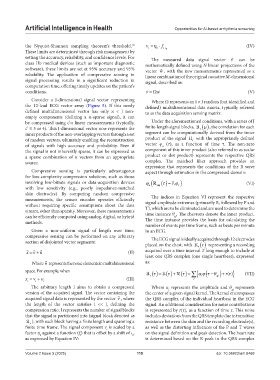
Artificial Intelligence in Health Opportunities for AI-based arrhythmia screening
the Nyquist-Shannon sampling theorem’s threshold. v 0 f (IV)
10
i
These limits are determined through risk management by i 0
setting the accuracy, reliability, and confidence levels. For The measured data signal vector v can be
class IIb medical devices (such as important diagnostic mathematically defined using N linear projections of the
software), these limits are set at 95% accuracy and 95% vector w , with the new measurements represented as a
reliability. The application of compressive sensing in linear combination of the original causative M-dimensional
signal processing results in a significant reduction in signal, described as:
computation time, offering timely updates on the patient’s
conditions. v w (V)
Consider a J-dimensional signal vector representing Where Ω represents an I × J random (but identified and
the 12-lead ECG vector array (Figure 5). If this newly defined) multidimensional data matrix, typically referred
defined multidimensional vector has only ϰ < J non- to as the data acquisition sensing matrix.
empty components (defining a ϰ-sparse signal), it can
be compressed using c’ϰ linear measurements (typically, Under the aforementioned conditions, with a series of J
c’ ≡ 3 or 4). This J-dimensional vector now represents the finite-length signal blocks, U , the correlation for each
r
inner products of the non-overlapping vectors through a set segment can be computationally derived from the inner
of random vectors, ultimately enabling the reconstruction product of the signal U with the appropriately defined
r
of signals with high accuracy and probability. Even if vector φ (τ), as a function of time τ. The non-zero
n
the signal is not inherently sparse, it can be expressed as component of this inner product (also referred to as scalar
a sparse combination of ϰ vectors from an appropriate product or dot product) represents the respective QRS
source. complex. The matched filter approach provides an
expression that represents the conditions of the R wave
Compressive sensing is particularly advantageous aspect through estimation in the compressed domain:
for low-complexity compression solutions, such as those
n
involving low-bitrate signals or data-acquisition devices v, (VI)
with low sensitivity (e.g., poorly impedance-matched U
skin electrodes). By computing random compressive
measurements, the sensor encoder operates efficiently The indices in Equation VI represent the respective
without requiring specific assumptions about the data signal amplitude extremes (primarily R, followed by P and
stream, other than sparsity. Moreover, these measurements T), which are to be eliminated and are used to determine the
time instance θ . The chevrons denote the inner product.
can be efficiently computed using analog, digital, or hybrid The time instance provides the basis for calculating the
χi
methods.
number of events per time frame, such as beats per minute
Given a non-uniform signal of length over time, in an ECG.
compressive sensing can be performed on any arbitrary The ECG signal is ideally acquired through 12 electrodes
section of disjointed vector segments: placed on the chest, with U representing a recording
r
acquired over a time interval T long enough to include at
xv n (II)
least one QRS complex (one single heartbeat), expressed
Where n represents the noise elements in multidimensional as:
space. For example, when
i
U r U i r () (VII)
x = v + n (III) i
i i i
The arbitrary length I aims to obtain a compressed Where α represents the amplitude and θ represents
i
χi
version of the acquired signal. The vector containing the the center of a given signal kernel. The kernel encompasses
acquired signal data is represented by the vector v , where the QRS complex of the individual heartbeat in the ECG
the length of the vector satisfies I << J, defining the signal. An additional consideration for noise contributions
compression ratio. J represents the number of signal blocks is represented by r(τ), as a function of time τ. This noise
that the signal is partitioned into (signal block denoted as includes deviations from the QRS template due to transition
U ), with each block having a finite length and spanning a resistance between the skin and the recording electrode(s),
r
finite time frame. The signal component v is scaled by a as well as the distorting influences of the P and T waves
i
factor η against a function (f ) that is offset by a shift of ι , on the signal definition and peak detection. The heart rate
0
0
i
as expressed by Equation IV: is determined based on the R peak in the QRS complex
Volume 2 Issue 3 (2025) 115 doi: 10.36922/aih.8468

