


Page 124 - AIH-2-3
P. 124
Artificial Intelligence in Health                              Opportunities for AI-based arrhythmia screening


            Table 2. A prospective spectrum of cardiac rhythm
            diagnostics and screening that can be quickly and
            automatically derived from an electrocardiogram

            Number                  Content
            1       1  degree atrioventricular block
                     st
            2       Atrial fibrillation
            3       Atrial flutter
            4       Bradycardia
            5       Complete the right bundle branch block
            6       Hypertrophic cardiomyopathy (also known as left
                    ventricular hypertrophy)
            7       Incomplete right bundle branch block
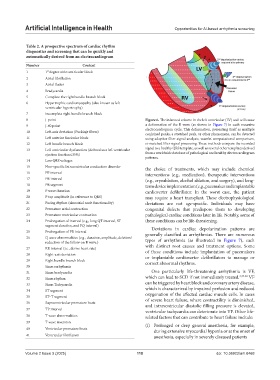
            8       J-point                                    Figure 6. The infarcted volume in the left ventricular (LV) wall will cause
            9       J-60 point                                 a deformation of the R wave (as shown in Figure 7) in each recursive
            10      Left-axis deviation (Purkinje fibers)      electrocardiogram cycle. This deformation, presenting itself as multiple
                                                               conjoined peaks, a stretched peak, or other phenomena, can be detected
            11      Left anterior fascicular block             using adaptive filter signal analysis, wavelet computational comparison,
            12      Left bundle branch block                   or matched filter signal processing. These methods compare the recorded
            13      Left ventricular dysfunction (defined as a left ventricular   signal to a healthy QRS template, as well as several other templates derived
                    ejection fraction≤35%)                     from a worldwide database of pathological and healthy electrocardiogram
                                                               patterns.
            14      Low QRS voltages
            15      Non-specific Intraventricular conduction disorder  the choice of treatments, which may include chemical
            16      PP interval                                interventions (e.g.,  medication), therapeutic interventions
            17      PR interval                                (e.g., cryoablation, alcohol ablation, and surgery), and long-
            18      PR segment                                 term device implementation (e.g., pacemaker and implantable
            19      P wave duration                            cardioverter defibrillator. In the worst case, the patient
            20      P top amplitude (in reference to QRS)      may require a heart transplant. These electrophysiological
            21      Pacing rhythm (sinoatrial node functionality)  deviations are not age-specific. Individuals may have
            22      Premature atrial contraction               congenital defects that predispose them to developing
            23      Premature ventricular contraction          pathological cardiac conditions later in life. Notably, some of
            24      Prolongation of interval (e.g., long QT interval, ST   these conditions can be life-threatening.
                    segment duration, and PQ interval)
                                                                 Deviations in cardiac depolarization patterns are
            25      Prolongation of PR interval                generally classified as arrhythmias. There are numerous
            26      Q wave abnormalities (e.g., duration, amplitude, deletion/  types of arrhythmia (as illustrated in  Figure  7), each
                    reduction of the follow-on R wave.)
            27      RR interval (i.e., derive heart rate)      with distinct root causes and treatment options. Some
                                                               of these conditions include implantation of pacemakers
            28      Right-axis deviation
            29      Right bundle branch block                  or implantable cardioverter defibrillators to manage or
                                                               correct abnormal rhythms.
            30      Sinus arrhythmia
            31      Sinus bradycardia                            One particularly life-threatening arrhythmia is VF,
            32      Sinus rhythm                               which can lead to SCD if not immediately treated. 4,47-50  VF
            33      Sinus Tachycardia                          can be triggered by heart block and coronary artery disease,
            34      ST segment                                 which is characterized by impaired perfusion and reduced
            35      ST–T segment                               oxygenation of the affected cardiac muscle cells. In cases
            36      Supraventricular premature beats           of severe heart failure, where contractility is diminished,
                                                               and intraventricular diastolic filling pressure is elevated,
            37      TP interval                                ventricular tachycardia can deteriorate into VF. Other life-
            38      T wave abnormalities                       related factors that can contribute to heart failure include:
            39      T wave inversion                           (i)  Prolonged or deep general anesthesia, for example,
            40      Ventricular premature beats                   during extensive myocardial hypoxia or at the onset of
            41      Ventricular fibrillation                      anesthesia, especially in severely diseased patients


            Volume 2 Issue 3 (2025)                        118                               doi: 10.36922/aih.8468

