


Page 115 - AIH-2-3
P. 115
Artificial Intelligence in Health                              Opportunities for AI-based arrhythmia screening


            A                                                  B


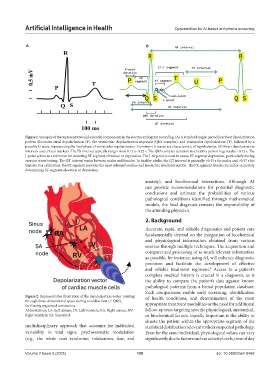
            Figure 1. Synopsis of the representative and essential components in the electrocardiogram recording. (A) A standard single-period heartbeat depolarization
            pattern illustrates atrial depolarization (P), the ventricular depolarization sequence (QRS complex), and ventricular repolarization (T), followed by a
            possible U wave, representing the final phase of ventricular repolarization. Prominent U waves are characteristic of hypokalemia. (B) Heart depolarization
            intervals and critical markers. The PR interval typically ranges from 0.12 to 0.22 s. The QRS complex duration in a healthy person is generally <0.12 s. The
            J-point serves as a reference for detecting ST segment elevation or depression. The J-60 point is used to assess ST segment depression, particularly during
            exercise stress testing. The QT interval varies between males and females. In healthy adults, the QT interval is generally <0.45 s for males and <0.47 s for
            females. For calibration, the PR segment provides the most relevant baseline and isoelectric level information. The PR segment level is crucial for accurately
            determining ST-segment elevation or depression.

                                                               anxiety), and biochemical interactions. Although AI
                                                               can  provide  recommendations  for  potential  diagnostic
                                                               conclusions and estimate the probabilities of various
                                                               pathological conditions identified through mathematical
                                                               models, the final diagnosis remains the responsibility of
                                                               the attending physician.

                                                               2. Background
                                                               Accurate, rapid, and reliable diagnostics and patient care
                                                               fundamentally depend on the integration of biochemical
                                                               and physiological information obtained from various
                                                               sources through multiple techniques. The acquisition and
                                                               computerized processing of as much relevant information
                                                               as possible, for instance, using AI, will enhance diagnostic
                                                               precision and facilitate the development of effective
                                                               and reliable treatment regimens.  Access to a patient’s
                                                                                          8
                                                               complete medical history is crucial in a diagnosis, as is
                                                               the ability to compare the patient’s data against known
                                                               pathological patterns from a broad population database.
                                                               Such comparisons enable early screening, identification
            Figure 2. Representative illustration of the depolarization vector rotating   of  health  conditions,  and  determination  of  the  most
            through three-dimensional space during a cardiac beat (P-QRS),
            facilitating organized contraction.                appropriate treatment modalities or the need for additional
            Abbreviations: LA: Left atrium; LV: Left ventricle; RA: Right atrium; RV:   follow-up tests targeting specific physiological, anatomical,
            Right ventricle; SA: Sinoatrial.                   or biochemical factors. Equally important is the ability to
                                                               situate the patient within the appropriate segment of the
            multidisciplinary approach that accounts for individual   statistical distribution relevant to their suspected pathology.
            variability  in  vital  signs,  psychosomatic  modulation   Even for the same individual, physiological values can vary
            (e.g.,  the white coat syndrome, infatuation, fear, and   significantly due to factors such as activity levels, time of day


            Volume 2 Issue 3 (2025)                        109                               doi: 10.36922/aih.8468

