


Page 13 - AIH-2-3
P. 13
Artificial Intelligence in Health                                           AI in embryo selection for ART


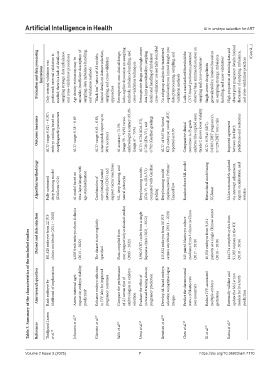
                 Evaluation and data processing   limitations  Only internal validation was  performed; external validation is  needed; there is a lack of details on  sampling strategy, data imbalance,  and cross-validation c  procedures  Age density estimation may be  unstable; insufficient description of  sampling, data imbalance handling,   and validation methods “Black box” nature of AI models;  limited details on dataset selection,  sampling, and cross‐validation   a


                 Outcome measures  AUC a  range: 0.621 – 0.707;   embryo ranking based on   morphogenetic parameters  AUC a  range: 0.58 – 0.69  AUC a  range: 0.63 – 0.83;   some models report up to   90% accuracy  AI accuracy: 75.5%   (range 59 – 94%) versus  embryologist accuracy: 65.4%   (range 47 – 75%)  AUC a : 0.736 (iDA-V2),   0.720 (iDA-V1), and   0.702 (Gardner grading)  AUC a  of 0.67 for Sorted   KID embryos; overall AUC   reported as 0.95  Comparative clinical


                 Algorithm/methodology  Fully automated   deep learning model   (iDAScore v2.0)  AI model based on   time‐lapse images with   age-standardization  Combination of   convolutional neural   networks (CNN) and   support vector machines  ML, deep learning, and   neural networks  Deep learning models   (iDA-V1 vs. iDA-V2)   compared with Gardner   grading  Deep learning model   implemented in Python/  TensorFlow  Random forest ML model  Hierarchical model using


                 Dataset and data selection  181,428 embryos from 22 IVF  clinics worldwide (2011 – 2020)  4,805 fresh embryos from 4 clinics   (2013 – 2022)  The dataset is not explicitly   specified  Data compiled from  non-prospectively evaluated studies   (2005 – 2022)  3,960 SVBT cycles from a single   Japanese clinic (2021 – 2022)  115,832 embryos from 18 IVF  centers worldwide (2011 – 2019)  345 paired blastocyst culture  mediums from 3 clinics in China   (2017 – 2


             Table 3. Summary of the characteristics of the included studies


                 Aim/research question  Rank embryos by   likelihood of implantation  Assess maternal age’s   impact on embryo viability   prediction b  Enhance embryo selection   in IVF labs for improved   pregnancy outcomes  Compare the performance   of AI versus that of   embryologists in embryo   selection  Evaluate the effect of   increased training data on   pregnancy prediction  Develop AI-based embryo   selection using time-lapse   images  Predict the chromosomal


                 References  Theilgaard Lassen   et al. 16  Johansen et al. 18  Glatstein et al. 20  Salih et al. 21  Ueno et al. 23  Berntsen et al. 24  Chen et al. 25  Xi et al. 26  Ratna et al. 27


            Volume 2 Issue 3 (2025)                         7                         https://doi.org/10.36922/aih.7170

