


Page 15 - AIH-2-3
P. 15
Artificial Intelligence in Health                                           AI in embryo selection for ART


                                                               transfer (ET), ICSI, and IVF.  These methods encompass
                                                                                      11
                                                               the in vitro manipulation of human gametes or embryos for
                 Evaluation and data processing   limitations Retrospective observational design  introduces bias; limited discussion on  sampling methods, data imbalance,   and cross-validation c  Age density estimation may be  unstable; insufficient description of  sampling, data imbalance handling,   and validation methods  spontaneous  conception.   Nonetheless,  conventional
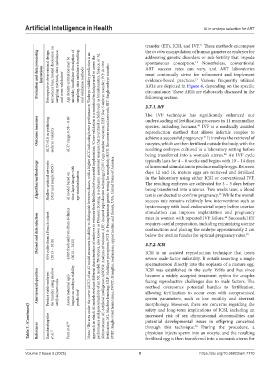
                                       Notes:  a The area under the curve (AUC) of an AI model measures its ability to distinguish between classes, with a higher AUC indicating better performance;  b Embryo viability prediction is an
                                           performance and generalizability of an ML model;  d DynScore, also known as Dynamic Scoring, is a dynamic assessment measure that is utilized in fields such as bioinformatics, finance, or AI.
                                                               addressing genetic disorders or sub-fertility that impede
                                         approach in which AI models evaluate different characteristics of embryos to estimate their likelihood of successful implantation;  c Cross-validation is a statistical technique used to assess the
                                                                                    12
                                             Abbreviations: AI: Artificial intelligence; ANOVA: Analysis of variance; ART: Assisted reproductive technology; CNV: Copy number variation; DET: Day-5 embryo transfer; IVF: In vitro
                                               fertilization; ML: Machine learning; MLP: Multilayer perceptron; PGT-A: Preimplantation genetic testing for aneuploidy; RNN: Recurrent neural network; SET: Single embryo transfer;
                                                               ART  success  rates  can  vary,  and  ART  laboratories
                                                               must continually strive for refinement and implement
                                                               evidence-based  practices.   Various  frequently  utilized
                                                                                    13
                                                               ARTs are depicted in Figure 4, depending on the specific
                                                               circumstance. These ARTs are elaborately discussed in the
                                                               following section.
                                                               3.7.1. IVF
                                                               The  IVF technique has significantly enhanced our
                 Outcome measures  AUC a >0.8 in predicting   embryo viability  AUC a  range: 0.58 – 0.69  species, including humans.  IVF is a medically assisted
                                                               understanding of fertilization processes in 11 mammalian
                                                                                     40
                                                               reproduction method that  allows infertile  couples  to
                                                               achieve a successful pregnancy.  It involves the retrieval of
                                                                                        41
                                                               oocytes, which are then fertilized outside the body, with the
                                                               resulting embryos cultured in a laboratory setting before
                                                               being transferred into a woman’s uterus.  An IVF cycle
                                                                                                42
                                                               typically lasts for 4 – 6 weeks and begins with 10 – 14 days
                 Algorithm/methodology  Shallow artificial networks   (MLP and simple RNN)  AI model based on   time‐lapse images with   age-standardization  days 12 and 16, mature eggs are retrieved and fertilized
                                                               of hormonal stimulation to produce multiple eggs. Between
                                                               in the laboratory using either ICSI or conventional IVF.
                                                               The resulting embryos are cultivated for 3 – 5 days before
                                                               being transferred into a uterus. Two weeks later, a blood
                                                               test is conducted to confirm pregnancy.  While the overall
                                                                                              43
                                                               success rate remains relatively low, interventions such as
                                                               hysteroscopy with local endometrial injury before ovarian
                                                               stimulation can improve implantation and pregnancy
                 Dataset and data selection  654 cycles from a French cohort   4,805 fresh embryos from 4 clinics   SVBT: Single-voxel brain tissue; SWOT: Strengths, weaknesses, opportunities, and threats; USA: United States of America.  requires careful preparation, including minimizing uterine
                                                                                                 44
                                                               rates in women with repeated IVF failure.  Successful ET
                                                               contractions and placing the embryo approximately 2 cm
                                                               below the uterine fundus for optimal pregnancy rates.
                                                                                                          45
                                (2013 – 2022)
                        (2013 – 2018)
                                                               3.7.2. ICSI
                                                               ICSI  is  an  assisted  reproduction  technique  that  treats
                                                               severe  male-factor  infertility.  It  entails  inserting  a  single
                                                               spermatozoon directly into the ooplasm of a mature egg.
                                                               ICSI was established in the early 1990s and has since
                 Aim/research question  Predict viable embryos   for transfer using shallow   artificial networks  Assess maternal age’s  impact on embryo viability   prediction b  become  a  widely  accepted  treatment  option  for  couples
                                                               facing reproductive challenges due to male factors. The
                                                               method overcomes potential hurdles to fertilization,
                                                               allowing fertilization to occur even with compromised
                                                               sperm parameters, such as low motility and aberrant
             Table 3. (Continued)  References  Kanakasabapathy   et al. 33  Pons et al. 34  morphology. However, there are concerns regarding the
                                                               safety and long-term implications of ICSI, including an
                                                               increased risk of sex chromosomal abnormalities and
                                                               potential developmental issues in offspring conceived
                                                                                    46
                                                               through this technique.  During the procedure, a
                                                               physician injects sperm into an oocyte, and the resulting


                                                                                      https://doi.org/10.36922/aih.7170
            Volume 2 Issue 3 (2025)                         9   fertilized egg is then transferred into a woman’s uterus for

