


Page 20 - AIH-2-3
P. 20
Artificial Intelligence in Health                                           AI in embryo selection for ART


            is transforming the landscape of ART.  This exploratory   4.3.1. RQ1: What are the current state-of-the-art AI
                                           29
            review  examines  recent  developments  in  embryo   technologies used in embryo selection for ART?
            selection and related AI-driven innovations within ART.  In ART, recent developments in AI have significantly

            4.2. Strength of the systematic review             improved embryo selection procedures. These cutting-
                                                               edge AI tools use ML, deep learning, and computer
            The strength of this systematic review lies in its   vision to increase the precision, reliability, and efficiency
            thorough  analysis  of  the  correlation  between  AI  and   of embryonic health evaluation. AI technologies are
            ART, particularly those concerning embryo selection.   transforming IVF laboratories by automating the
            The review thoroughly explains the opportunities,   assessment  of  embryo  morphology  and  leveraging
            challenges, and future directions in using AI to improve   synthetic data. The primary AI tools currently employed in
            ART outcomes by analyzing a wide range of literature   embryo selection are listed below:
            from the past 10 years. This paper is the first to highlight   (i)  Computer vision and deep learning: Computer
            the need for external validation of prediction models,   vision and deep learning are used by AI systems
            an aspect that requires significant improvement in    to automatically examine images of embryo
            the reviewed studies. Most of the scientific papers   morphology and extract important aspects that are
            used  retrospective  and anonymized data,  which  may   essential for determining the survival of the embryo.
            introduce biases and limit the generalization of findings.   The accuracy of embryo selection is improved, and
            Therefore, this systematic review combines an in-depth   the subjectivity associated with manual assessments
            analysis  of various  documents from several countries,   by embryologists is reduced.  For example, deep
                                                                                           92
            thus reducing bias and highlighting its potential to   learning algorithms that have been trained on both
            transform the field of ART. It also highlights ethical   synthetic and actual embryo images have shown
            considerations  and  emphasizes  the  significance  of   excellent accuracy in predicting the stages of embryo
            responsible implementation in clinical practice. With   cells, reaching up to 97% accuracy when synthetic
            its in-depth analysis and interdisciplinary approach,   data is included. 93
            the review provides valuable insights for researchers,   (ii)  Time-lapse  imaging:  AI  systems  use  time-lapse
            clinicians, and policymakers, facilitating informed   imaging to improve predictions from fertilization to
            decision-making. In addition, four key parameters     the blastocyst stage, thereby increasing IVF success
            have  been  identified  –  ethical  concerns,  clinical  and   rates by identifying viable embryos more accurately
            regulatory constraints, discussion of AI techniques, and   than human experts. 94
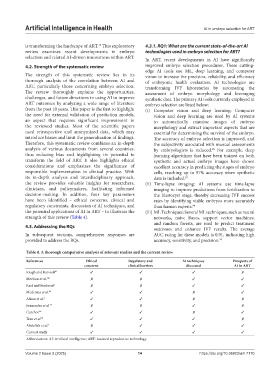
            the potential applications of AI in ART – to illustrate the   (iii) ML Techniques: Several ML techniques, such as neural
            strength of this review (Table 4).                    networks, naive Bayes, support vector machines,
                                                                  and random forests, are used to predict treatment
            4.3. Addressing the RQs                               outcomes  and  enhance  IVF  results.  The  average

            In  subsequent  sections,  comprehensive  responses  are   AUC rating for these models is 0.91, indicating high
            provided to address the RQs.                          accuracy, sensitivity, and precision. 94

            Table 4. A thorough comparative analysis of relevant studies and the current review

            References                Ethical           Regulatory and         AI techniques        Prospects of
                                     concerns           clinical barriers       discussed            AI in ART
            Kragh and Karstoft 87      ✓                    ✓                      ✓                   ✗
            Merican et al.  88         ✗                    ✗                      ✓                   ✓
            Raef and Ferdousi 4        ✗                    ✗                      ✓                   ✓
            Medenica et al. 89         ✓                    ✓                      ✗                   ✓
            Afnan et al. 9             ✓                    ✓                      ✗                   ✗
            Fernandez et al. 13        ✗                    ✗                      ✓                   ✗
            Curchoe 90                 ✓                    ✓                      ✗                   ✓
            Tran et al. 91             ✓                    ✓                      ✓                   ✗
            Abdullah et al. 3          ✗                    ✓                      ✓                   ✓
            Current study              ✓                    ✓                      ✓                   ✓
            Abbreviations: AI: Artificial intelligence; ART: Assisted reproductive technology.


            Volume 2 Issue 3 (2025)                         14                        https://doi.org/10.36922/aih.7170

