


Page 14 - AIH-2-3
P. 14
Artificial Intelligence in Health                                           AI in embryo selection for ART


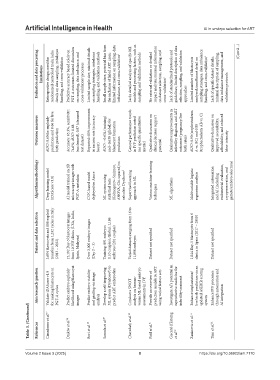
                 Evaluation and data processing   limitations  Retrospective design; need for  randomized controlled trials; lacks  details on data sampling, imbalance  handling, and cross-validation Predictive accuracy based solely on  PGT-A outcomes; limited discussion  on sampling, data imbalance, and  cross-validation c  processes Limited sample size; minimal details  on sampling strategies, imbalance  handling, and validation methods Small sample sizes; potential bia


                 Outcome measures  AUC a : 0.60 for euploidy   prediction and 0.66 for live   birth prediction  Accuracy: 65.3%, sensitivity:   74.6%; AUC a : 0.68  (uncleaned), 0.87 (cleansed   test dataset)  Reported>85% improvement   in success rate (accuracy   boost)  AUC a : ~0.634 (training)   and~0.638 (global) for   blastocyst formation   prediction  General performance trends   in IVF prediction noted   (no specific quantitative   metric)  Qualitative discussion


                 Algorithm/methodology  Deep learning model   (iDAScore v1.0)  AI model trained on 2D   microscope images with   PGT-A metadata  CNN-based model   deployed on Azure  ML system using   statistical tests   (Kolmogorov–Smirnov,   ANOVA, Chi-squared) to   calculate DynScore d  Supervised learning   approach in ML   Various machine-learning   techniques  ML algorithms  Multivariable logistic   regression analysis  Integrated automation   and AI (including   end


                 Dataset and data selection  3,604 blastocysts and 808 euploid  transfers from 1,232 cycles in Italy   (2013 – 2022)  15,192 Day-5 blastocyst images  from 10 IVF clinics (USA, India,   Spain, Malaysia)  Over 3,000 embryo images   (Day 2 – 3)  Training: 891 embryos  (110 couples); Global: 1,186   embryos (201 couples)  Varied datasets ranging from 16 to   11,898 embryos  Dataset not specified  Dataset not specified  1,044 Day-5 blastocysts from 6  clinics i


                 Aim/research question  Validate iDAScore v1.0   for ranking blastocysts in   PGT-A cycles  Predict embryo euploidy  likelihood using blastocyst   images  Predict embryo viability   and grading via image   analysis  Develop a self-improving   ML system (DynScore d ) to   predict ART embryo fate  Conduct a SWOT   analysis on human-   versus ML-based embryo   assessments in IVF  Provide an overview of   prediction models in ART   using varied feature sets  I


             Table 3. (Continued)  References  Cimadomo et al. 17  Diakiw et al. 28  Bori et al. 19  Sawada et al. 29  Cheredath et al. 30  Patil et al. 31  Giscard d’Estaing   et al. 32  Zaninovic et al. 14  Tian et al. 22


            Volume 2 Issue 3 (2025)                         8                         https://doi.org/10.36922/aih.7170

