


Page 114 - AIH-2-4
P. 114
Artificial Intelligence in Health                                  Autonomic nervous system patterns in men


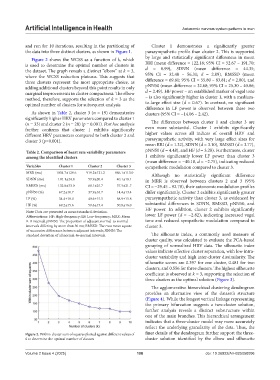
            and run for 10 iterations, resulting in the partitioning of   Cluster 1 demonstrates a significantly greater
            the data into three distinct clusters, as shown in Figure 1.  parasympathetic profile than cluster 2. This is supported
              Figure  2 shows the WCSS as a function of  k, which   by  large  and  statistically  significant  differences  in  mean
            is used to determine the optimal number of clusters in   RRI (mean difference = 122.18; 95% CI = 52.67 – 191.70;
            the dataset. The graph reveals a distinct “elbow” at k = 3,   d  = 0.99), SDNN (mean difference =  44.35;
            where the WCSS reduction plateaus. This suggests that   95% CI = 32.40 – 56.31;  d  =  2.09), RMSSD (mean
            three clusters represent the most appropriate choice, as   difference = 69.81; 95% CI = 55.80 – 83.81; d = 2.80), and
            adding additional clusters beyond this point results in only   pNN50 (mean difference = 32.68; 95% CI = 25.30 – 40.06;
            marginal improvements in cluster compactness. The elbow   d = 2.49). HF power – an established marker of vagal tone
            method, therefore, supports the selection of k = 3 as the   – is also significantly higher in cluster 1, with a medium-
            optimal number of clusters for subsequent analysis.  to-large effect size (d = 0.67). In contrast, no significant
                                                               difference in LF power is observed between these two
              As shown in Table 2, cluster 3 (n = 19) demonstrates   clusters (95% CI = −14.06 – 2.42).
            significantly higher HRV parameters compared to cluster 1
            (n = 33) and cluster 2 (n = 28) (p = 0.001). Post hoc analysis   The differences between cluster 1 and cluster 3 are
            further confirms that cluster 1 exhibits significantly   even more substantial. Cluster 1 exhibits significantly
            different HRV parameters compared to both cluster 2 and   higher values across all indices of overall HRV and
            cluster 3 (p=0.001).                               parasympathetic activity, with very large effect sizes for
                                                               mean RRI (d = 1.32), SDNN (d = 3.10), RMSSD (d = 3.77),
            Table 2. Comparison of heart rate variability parameters   pNN50 (d = 4.48), and HF (d = 3.28). Furthermore, cluster
            among the identified clusters                      1 exhibits significantly lower LF power than cluster 3
                                                               (mean difference = −40.18, d = −2.75), indicating reduced
            Variables     Cluster 1   Cluster 2    Cluster 3   sympathetic modulation compared to cluster 3.
            MRR (ms)     1034.7±129.6  919.2±121.2  886.1±113.0  Although no statistically significant difference
            SDNN (ms)     101.1±24.8   59.9±20.4   40.1±18.1   in MRR is observed between clusters 2 and 3  (95%
            RMSSD (ms)    132.8±33.0   68.1±25.7   37.5±21.7   CI = −29.45 – 92.78), their autonomic modulation profiles
            pNN50 (%)     67.2±10.7    37.9±16.7   14.4±13.4   differ significantly. Cluster 2 exhibits significantly greater
            LF (%)        34.4±18.0    40.6±15.5   68.9±15.8   parasympathetic activity than cluster 3, as evidenced by
            HF (%)        69.2±15.6    59.6±15.4   30.8±16.0   substantial differences in SDNN, RMSSD, pNN50, and
            Note: Data are presented as mean±standard deviation.  HF power. In addition, cluster 2 exhibits significantly
            Abbreviations: HF: High-frequency; LF: Low-frequency; MRR: Mean   lower LF power (d = −2.82), indicating increased vagal
            R-R interval; pNN50: The proportion of adjacent normal-to-normal   tone and reduced sympathetic modulation compared to
            intervals differing by more than 50 ms; RMSSD: The root mean square   cluster 3.
            of successive differences between adjacent intervals; SDNN: The
            standard deviation of all normal-to-normal intervals.   The  silhouette  index,  a  commonly  used  measure  of
                                                               cluster quality, was calculated to evaluate the PCA-based
                                                               grouping of normalized HRV data. The silhouette index
                                                               values indicate effective cluster separation, with low intra-
                                                               cluster variability and high inter-cluster dissimilarity. The
                                                               silhouette scores are 0.397 for one cluster, 0.481 for two
                                                               clusters, and 0.556 for three clusters. The highest silhouette
                                                               coefficient is observed at k = 3, supporting the selection of
                                                               three clusters as the optimal solution (Figure 3).
                                                                 The agglomerative hierarchical clustering dendrogram
                                                               provides  an  alternative  view  of  the  dataset’s  structure
                                                               (Figure 4). While the longest vertical linkage representing
                                                               the primary bifurcation suggests a two-cluster solution,
                                                               further analysis  reveals a  distinct  substructure within
                                                               one of the main branches. This hierarchical arrangement
                                                               indicates that a three-cluster model may more accurately
                                                               reflect the underlying granularity of the data. Thus, the
            Figure 2. Within-cluster sum of squares plotted against different values of   finer details of the dendrogram further support the three-
            k to determine the optimal number of clusters      cluster  solution  identified  by  the  elbow  and  silhouette


            Volume 2 Issue 4 (2025)                        108                          doi: 10.36922/AIH025050006

